
Technical SEO · June 2026 · 14-minute read
Your Page Was Crawled.
It Wasn’t Indexed.
Here’s Why — and What’s Actually Happening.
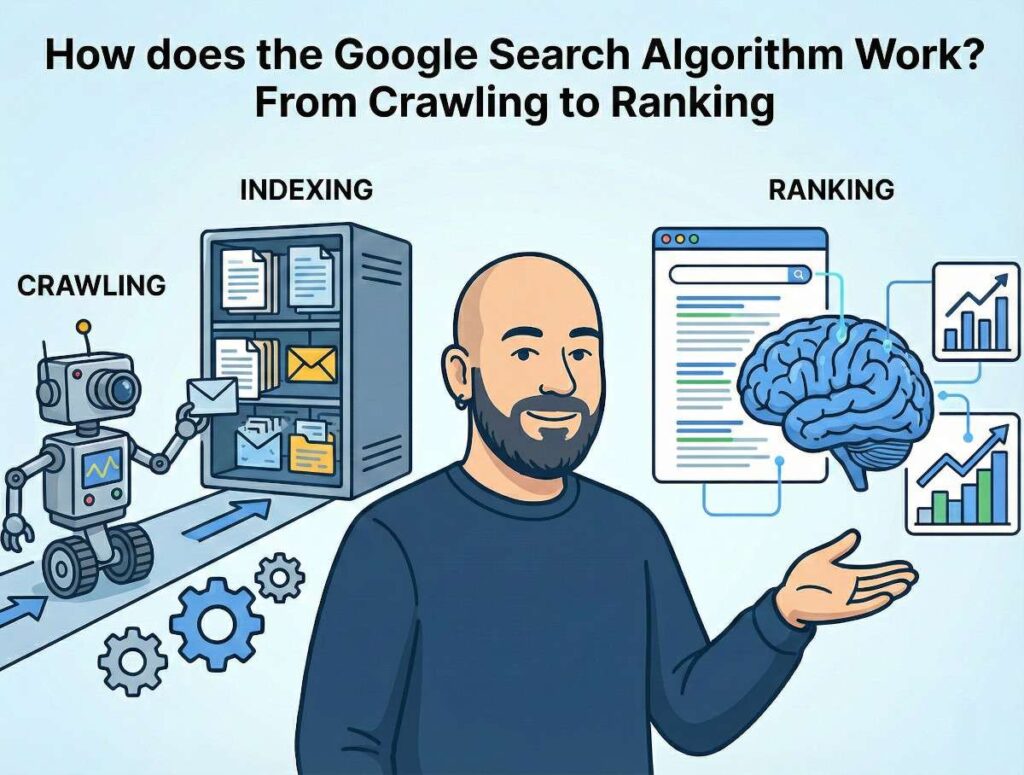
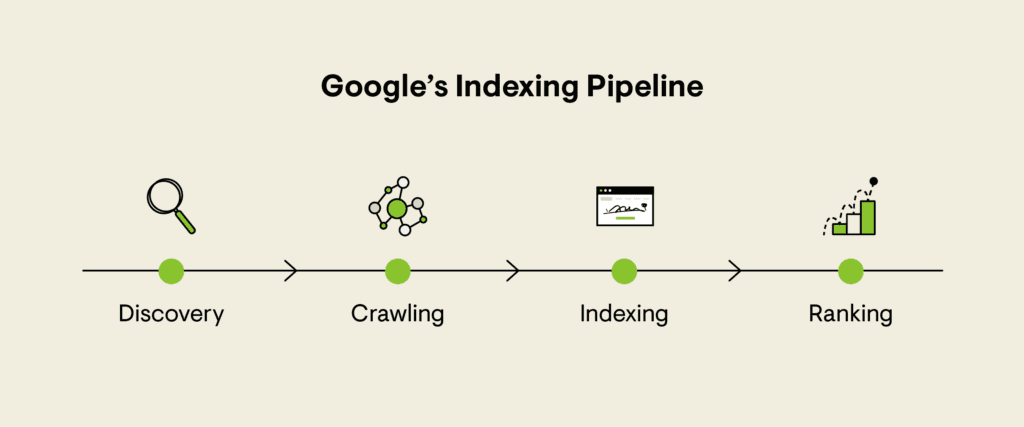
Inside Google’s real-time indexing pipeline: from the moment Googlebot arrives to the decision that puts your page in Base — or buries it in Landfills.
A client of mine — a mid-sized e-commerce operator with 3,400 product pages — ran a routine Search Console audit in April 2026. Of those 3,400 URLs, 2,980 sat at “Discovered — currently not indexed.” Not blocked. Not noindexed. Discovered. Meaning Google had seen them, decided they weren’t worth processing yet, and moved on.
That distinction — between crawled and indexed — is where most SEO advice falls apart. People optimize for discovery when the real fight happens 30 milliseconds after Googlebot leaves.
This piece is about what happens in those 30 milliseconds, and the minutes, hours, and sometimes weeks that follow. Not the marketing version. The operational version — including what the 2024 API leak actually revealed about Google’s internal index architecture that Google itself never disclosed.
“Real-Time Indexing” Is a Partial Truth
Google has been calling its system real-time since the Caffeine rollout in 2010, when the company said the update delivered 50% fresher results compared to the previous layered index. That claim is technically accurate and operationally misleading at the same time.
Caffeine is real-time in the sense that pages are analyzed as they’re crawled — there’s no batch-processing delay between “Googlebot fetched this page” and “Google starts evaluating it.” But real-time analysis is not the same as real-time indexing. What determines whether your page gets indexed today, next week, or never isn’t the analysis speed. It’s the crawl priority assigned before Googlebot even knocks on your server.
Caffeine processes pages in real time. Whether those pages reach the crawl queue at all — that’s the actual bottleneck. A page Google knows about but hasn’t prioritized sits in “Discovered — currently not indexed” status indefinitely.
The practical implication: if you publish content and it doesn’t appear within 48–72 hours, the problem usually isn’t analysis speed. It’s that your page didn’t make it far enough up the priority queue to get fetched in the first place.
The Crawl Priority Engine — What Actually Runs It
Google’s crawl scheduler isn’t documented publicly, but from a combination of the 2024 API leak analysis by Mike King at iPullRank, patent filings, and empirical behavior, the priority system operates on roughly four input classes:
1. PageRank (not the toolbar version — the live one)
The leak confirmed seven variants of PageRank in active use. Pages with stronger internal link equity from already-indexed, high-authority pages get crawled more often and more quickly. This is why a new post on a domain with strong existing content can index in minutes, while an identical post on a new domain can wait weeks.
2. Freshness signals
Documents that have changed recently — measured by HTTP headers, content hashes, and sitemap lastmod values — receive elevated priority. The system learns your update patterns: if your news section historically publishes every six hours, Googlebot allocates more crawl bandwidth to that path.
3. Crawl budget allocation
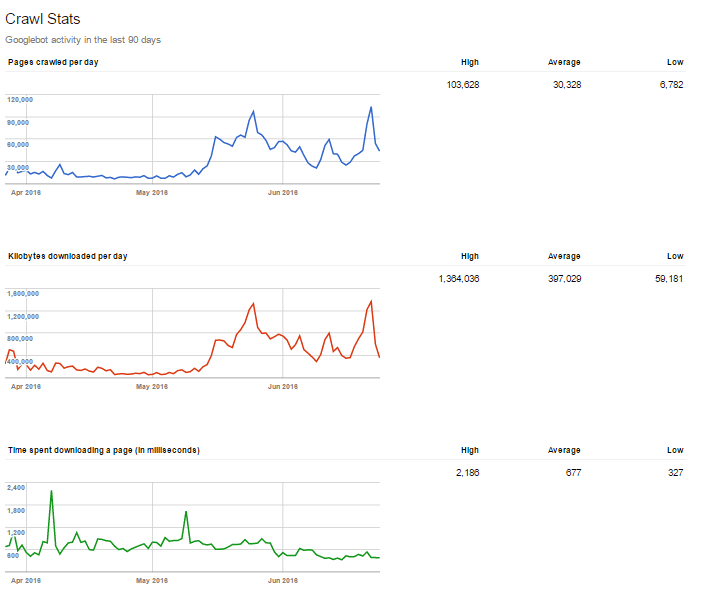
Each site receives a crawl budget — effectively a rate limit on how many pages Googlebot will fetch per unit of time. Faceted navigation is responsible for roughly 50% of crawl budget issues observed in 2025–2026 audits, because parameter-driven URLs multiply the apparent page count exponentially without adding indexable value.
4. Server response quality
Response time directly affects crawl rate. A server that responds in 200ms gets crawled more aggressively than one that takes 2.2 seconds. Google self-throttles to avoid overloading slow servers, which inadvertently rewards fast infrastructure with more frequent visits.
The Rendering Gap: What Googlebot Actually Sees
After Googlebot fetches a page, it doesn’t immediately process it. The raw HTML goes into a rendering queue — Google’s Web Rendering Service (WRS), which runs a headless version of Chrome. This is where JavaScript-heavy sites create a structural disadvantage that doesn’t show up in any standard SEO audit.
The fetch and the render happen at different times. Sometimes minutes apart. Sometimes hours. In 2025–2026, improvements brought WRS closer to the latest Chrome versions, but the delay still exists — and any content dependent on JavaScript that fires after the initial page load risks being invisible to the indexer.
If your product descriptions, H1 tags, or internal link anchors are rendered by JavaScript rather than present in the initial HTML response, Google may index a skeleton version of your page. The rendered content arrives later — sometimes after the indexing decision has already been made.
The practical test: request your URL via Google Search Console’s URL Inspection tool and examine the rendered HTML. If what you see in “View Tested Page” doesn’t match what a human sees in a browser, you have a rendering gap.
The Three Tiers Nobody Told You About (Until They Leaked)
This is the part that reframes everything. Until May 2024, Google officially denied having anything resembling a domain authority score. It also never publicly documented how content was stored and prioritized within the index itself. Then the API documentation leaked.
What the 2024 leak revealed — first surfaced by Rand Fishkin and decoded by Mike King of iPullRank — is that Google’s index is stratified into three named tiers managed by a system called SegIndexer:
| Tier | Internal name | Storage type (King’s analysis) | What it means | Crawl frequency |
|---|---|---|---|---|
| Base | Base | Flash storage | Highest priority, fastest access. Where you want your pages. | Near-continuous |
| Zeppelins | Zeppelins | SSD | Medium importance. Updated regularly but not constantly. | Daily–weekly |
| Landfills | Landfills | HDD | Low priority or rarely updated. May surface for obscure queries only. | Weeks–months |
The attribute governing placement is called scaledSelectionTierRank — a language-normalized score that places each document in its fractional position within the quality hierarchy. What’s critical to understand: this tier assignment isn’t just about where your page is stored. It affects link equity. According to the leaked AnchorsAnchor module documentation, links from Base-tier pages carry significantly more weight than links from Landfill-tier pages. The link economy is tiered too.
What puts you in Landfills? The Panda system — still very much active — creates what the docs call “long-term algorithmic debt.” Signals like pandaDemotion, babyPandaDemotion, and low vlq (very low quality) scores persist. They don’t reset on the next crawl. A site that published thin content in 2023 and cleaned it up in 2025 may still be carrying Panda debt into 2026.
What Caffeine Actually Does (and Doesn’t Do)
Caffeine is the indexing infrastructure layer, not an algorithm. Think of it as the factory floor — it determines how fast raw content moves from “fetched” to “stored in the index.” It’s been in production since 2010 and has been incrementally improved since.
Its core innovation was replacing Google’s previous batch-update model — where the entire index was refreshed periodically in large chunks — with a continuous, incremental system. New content is analyzed and incorporated into the serving index as soon as it’s processed, without waiting for a full cycle to complete.
What Caffeine doesn’t control: which tier your content lands in, how often your URLs get crawled, or whether they make it to the crawl queue at all. Those are separate systems with their own inputs.
For a high-authority news site publishing breaking content, Caffeine genuinely delivers near-real-time indexing — sometimes under 2 minutes via the Google Indexing API. For a new blog with 12 backlinks, “real-time” means “within 3–6 weeks, maybe never.” The pipeline is the same. The priority allocation is not.
AI Changes the Crawl Pipeline — But Not How Most People Think
Since 2025, Googlebot has operated alongside a growing fleet of AI-specific crawlers. As of mid-2026, Google’s AI Mode — the generative search interface — surfaces “preferred sources” in AI Overviews and AI Mode, each clearly labelled, alongside traditional SERP results. Getting selected as a preferred source and getting ranked in the top-10 are increasingly divergent optimization targets.
Three things have changed in the crawl pipeline specifically because of AI:
Context-aware rendering
Google’s crawler now adapts its rendering pipeline based on content type, using MUM (Multitask Unified Model) to understand relationships between content formats. A page with tightly structured, machine-readable information is processed differently from one with unstructured narrative text.
The llms.txt signal
A new 2025–2026 standard worth implementing: the llms.txt file in your site root — effectively a robots.txt equivalent structured for language model consumption. It provides LLMs with a concise, structured description of your site and its key content in a format they parse far more efficiently than standard HTML. It’s not a ranking signal yet. It’s infrastructure for what’s coming.
Google-Extended opt-out
Googlebot’s crawling now supports both traditional indexing and AI training data collection. Sites that want to opt out of training data specifically — while remaining indexed — can use Google-Extended in their robots.txt. This is distinct from blocking Googlebot entirely.
The Information Gain Problem — Why Good Content Still Doesn’t Index
Here’s the failure mode I haven’t seen explained accurately anywhere: a page can be technically perfect and still fail to index because of what the system internally calls “Information Gain.”
In the 2025–2026 period, a regional portal with 750 server-side rendered pages saw 96% of its URLs fail to index. The site was technically clean — fast, properly structured, no crawl blocks. The 342:1 ratio of “Discovered” to “Crawled” URLs pointed to a single cause: insufficient Information Gain. Google determined that most of those pages added nothing to what was already indexed.
Information Gain isn’t just about uniqueness. It’s about whether your content changes the user’s understanding of a topic in a way that Google doesn’t already have covered elsewhere in its index. Aggregated, summarized, or slightly-reworded content fails this test even when it passes plagiarism checks. The question isn’t “is this original?” but “does the index need this?”
Before publishing, ask: if a user already read the top three results for this query, does your page give them something they don’t have yet? A specific data point, a distinct perspective, a documented experience, an analysis nobody else has run? If the honest answer is “not really” — don’t publish yet. Publishing low-Information-Gain content at scale is one of the fastest ways to train SegIndexer to route your domain toward Landfills.
What You Can Actually Control
Given everything above, here’s where intervention is meaningful versus where it isn’t.
| Lever | What it affects | Impact | Reality check |
|---|---|---|---|
| GSC URL Inspection → Request Indexing | Raises individual URL priority in crawl queue | Medium–High (for new content) | Doesn’t guarantee indexing; signals “this matters now” |
XML Sitemap with accurate lastmod | Crawl scheduler freshness signals | Medium | Only useful if lastmod is accurate — lying about it trains the system to ignore you |
| Internal linking from indexed, high-authority pages | Link equity + crawl path signal | High | The most reliable lever. A link from a Base-tier page is worth more than 50 sitemap entries. |
| Eliminating parameter URLs / faceted nav | Crawl budget recovery | High (for large sites) | Blocking irrelevant URLs via canonical or robots.txt returns budget to valuable pages |
| Google Indexing API | Directly triggers crawl, often within minutes | High (for eligible content) | Officially documented only for job postings and live streams; used more broadly with mixed results |
| Server response time <200ms | Crawl rate allocation | Medium | Consistently fast servers get visited more often — the math compounds over months |
| Removing thin/low-Information-Gain content | Domain-level quality signals, tier assignment | High (long-term) | Sites that removed 30–40% of thin pages in 2025–2026 saw faster recoveries post-core-update |
Quick-audit checklist before your next publish
- Server-side rendered HTML contains all critical content (H1, meta description, main body text, internal links)
- New URL has at least one contextual internal link from an already-indexed, linked-to page
- URL is included in sitemap with accurate
lastmod - Page adds something the existing top-3 results don’t have
- No parameter variations of this URL are being generated (check faceted nav / sorting / filtering)
- Do not use “Request Indexing” for more than ~10 URLs per day — GSC rate-limits this and overuse reduces its effectiveness
- Do not update
lastmodwithout making a meaningful content change — Google tracks the accuracy of this signal
The Part Nobody Has Mapped Yet
There’s a question I genuinely don’t have a clean answer to: how does a page move between tiers after initial placement?
The leak documents suggest tier rank is recalculated — the scaledSelectionTierRank isn’t set once and frozen. But the recalculation frequency and the specific signals that trigger upward movement are opaque. What’s known from empirical behavior: pages that consistently attract clicks, generate dwell time, and earn fresh backlinks appear to migrate upward. Pages that stagnate — same content, declining engagement, no new inbound links — appear to drift toward lower tiers over time.
Whether this is a continuous gradient or a periodic batch re-score, nobody outside Google knows with certainty. Including me. If you have Search Console data showing tier-movement patterns, I’d genuinely be interested — it’s one of the gaps in current public knowledge that matters most for technical SEO strategy.
This piece connects directly to how crawl budget decisions affect site architecture choices — a topic covered in depth at SEOHack.info. If you’re working through a discovery-vs-indexing gap in Search Console, the technical audit framework there gives you a structured sequence for diagnosing which pipeline stage is failing.