
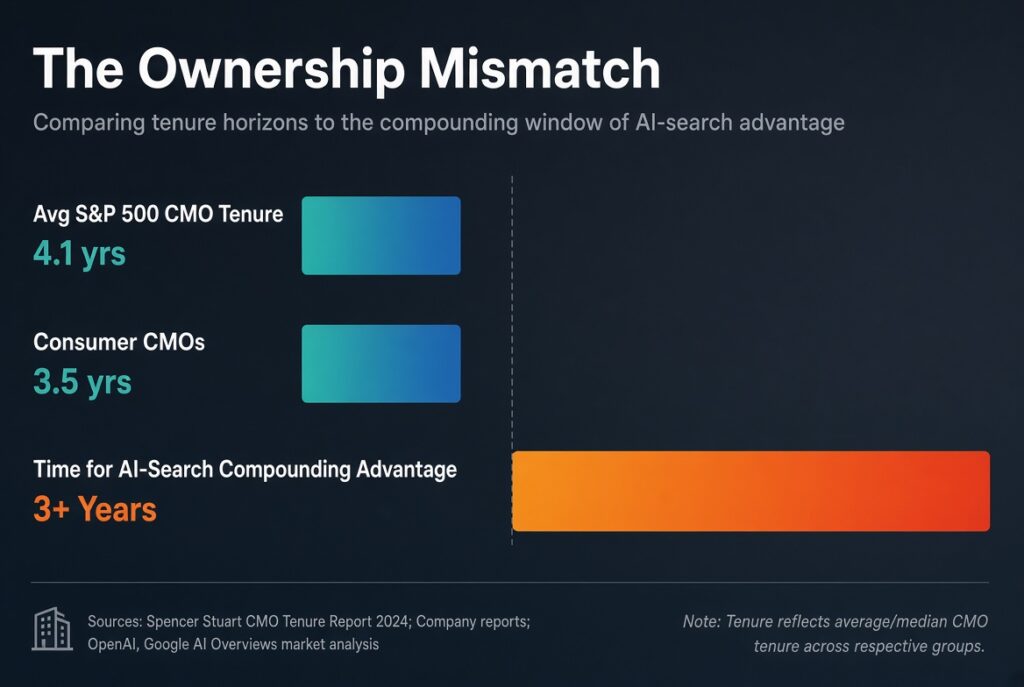
A chief marketing officer stays in the role an average of 4.1 years, while the compounding advantage from AI-search investment takes several budget cycles to consolidate. When the person accountable for a decision rotates out before the decision pays off, the decision has to move up a level — which is why SEO in 2026 belongs on the CEO’s agenda, not just the CMO’s dashboard, even though most companies still run it the old way.
TL;DR
- Organic click-through rates at the #1 ranking position have fallen from roughly 39.8% to 27.6% since AI Overviews scaled, and a separate 300,000-keyword study puts the AI-Overview-specific effect at a 58% CTR drop — this is now a revenue-line problem, not a rankings problem.
- The average CMO tenure at S&P 500 companies is 4.1 years, and 31% of S&P 500 companies currently have no CMO at all — the role most likely to “own” search is structurally too short-lived and, in nearly a third of large companies, unfilled.
- Fixing visibility in AI answer engines requires authority over engineering, product content, and legal review — resources that sit outside a CMO’s direct control and inside a CEO’s.
- Enterprises with mature AI-search programs are pulling ahead 2–3x faster than laggards; late movers face a gap that budget alone won’t close.
- CEO ownership does not mean CEOs writing meta descriptions. It means CEOs holding the cross-functional mandate and the multi-year commitment that this shift actually requires.
The Rankings Didn’t Move. The Business Did.
Most companies still track SEO the way they tracked it in 2019: rank position, organic sessions, a monthly report that lands in the CMO’s inbox. That measurement model made sense when a page-one ranking reliably converted into a click. It stopped making sense sometime in 2025, and the data on how much it stopped making sense is now large enough to act on.
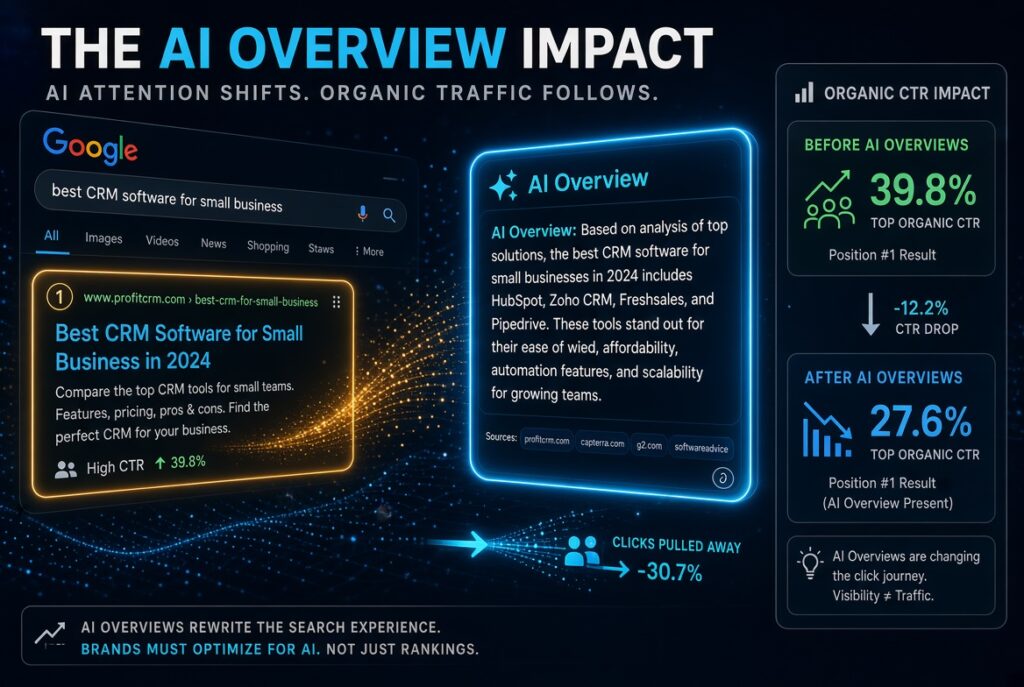
Google’s AI Overviews now appear on a majority of informational queries and a substantial share of commercial ones. A 2026 analysis of 21.7 million Google Search Console impressions found that organic click-through rate at the #1 position has fallen to 27.6%, down from 39.8% before AI Overviews scaled — a 30.6% reduction in clicks for a page that never moved in the rankings. Ahrefs ran a separate, larger study — 300,000 keywords split evenly between queries with and without an AI Overview — and isolated the AI-Overview-specific effect at a 58% CTR drop for the top-ranking result as of December 2025. Seer Interactive’s tracking of 42 organizations across 25 million impressions found organic CTR on AI-Overview queries falling from 1.76% to 0.61% between June 2024 and September 2025, with paid CTR on the same queries falling even further.
These three studies don’t agree on exact magnitude — they use different baselines, different query mixes, and different time windows, and a serious reader should treat the absolute numbers as directionally consistent rather than interchangeable. But they agree on the direction and the order of magnitude: a top ranking now converts to roughly a third to two-thirds fewer clicks than it did two years ago, for the same content, in the same position. That is not a marketing execution problem. That is a change in what a page-one ranking is worth to the company’s revenue line, and revenue-line changes are a CEO’s job to understand, even when marketing still does the operational work.
Full source data: Visionary Marketing’s 2026 CTR-by-position study, Ahrefs’ AI Overviews CTR update, and Seer Interactive’s research as covered by PPC Land.
The Ownership Problem Nobody Is Pricing In
Here is the part of this story that gets skipped in most SEO commentary: the shift toward AI-mediated search doesn’t just change tactics. It changes the required time horizon for the investment to pay off — and the people currently accountable for that investment don’t have that horizon.
Spencer Stuart’s 2026 CMO Tenure Study, based on 346 named marketing chiefs at S&P 500 companies, found an average CMO tenure of 4.1 years — the shortest of any core C-suite role except COO, itself often a stepping-stone position. Nearly a third of S&P 500 companies (31%) currently have no CMO at all. Consumer companies, where marketing typically has the most influence over the topic at hand, have the shortest CMO tenure of any industry analyzed: 3.5 years.
Meanwhile, Conductor’s 2026 AEO/GEO CMO Investment Report — a survey of more than 250 senior executives responsible for AI-search strategy at enterprise organizations — found that 94% of enterprises plan to increase AEO/GEO investment in 2026, and that high-maturity organizations are compounding their advantage: they are 2x more likely than medium-maturity organizations, and 3x more likely than low-maturity organizations, to significantly increase investment again in the following year. That is a market where being early doesn’t just help — it multiplies. Citation authority in AI answer engines is self-reinforcing: models tend to keep citing sources that have already been established as trustworthy references, so an early lead compounds while a late start starts from a colder position with every subsequent model refresh.
Put those two data points next to each other, and the mismatch is direct: the initiative that most rewards a multi-year, compounding commitment sits under the executive role least likely to still be in the seat when the compounding pays off.
A CMO who launches an AI-search governance program in year one is, on average, gone before the maturity curve that Conductor’s own data describes has fully consolidated. Whoever inherits that CMO’s chair inherits either a compounding asset or an abandoned initiative, and which one they inherit depends on whether someone above the CMO level held the mandate in the meantime.
Why This Stopped Being a Marketing-Only Fix
The instinct to leave this with the CMO comes from treating AI-search readiness like a content or keyword problem. It isn’t, not anymore. Getting cited reliably inside AI Overviews, ChatGPT, Perplexity, and Gemini responses depends on a set of technical and organizational conditions that sit outside a typical marketing team’s authority:
- Structured, machine-parseable content architecture — schema markup, clean entity definitions, consistent product and pricing data — usually requires engineering sprint time that marketing has to request, not command.
- Crawlability and server-side rendering for AI crawlers, which behave differently than Googlebot and often can’t execute the JavaScript-heavy front ends product teams ship by default.
- Product and pricing data accuracy, since AI systems increasingly pull specifications and prices directly into answers — an error here is not an SEO problem; it’s a legal and customer-trust problem.
- Legal and brand review of what the company is comfortable being quoted as saying inside an AI-generated answer the company doesn’t control the framing of, which is a governance and risk question, not a copywriting one.
Conductor’s own survey data reflects this split: C-suite leaders in the study most frequently cited scaling AI-optimized content as their top challenge, while marketing and AEO specialists emphasized ensuring AI systems can reliably crawl and access content in the first place — a technical, engineering-adjacent problem. Two different functions are looking at two different bottlenecks, and neither can fully resolve its half without the other.
| Marketing-owned SEO (legacy model) | CEO-sponsored AEO/GEO governance | |
|---|---|---|
| Budget ceiling | Capped inside marketing’s line, which averaged 7.7% of company revenue in Gartner’s 2025 CMO Spend Survey — flat for a second straight year, with 59% of CMOs reporting insufficient budget to execute their strategy | Funded as a cross-functional initiative with its own line item, not squeezed out of an already-flat marketing budget |
| Engineering access | Requested through standard sprint prioritization, competing with product roadmap | Prioritized as a named initiative with executive sponsorship |
| Time horizon | Tied to the current CMO’s tenure and annual planning cycle | Set to the multi-year window the compounding advantage actually requires |
| Accountable owner | Marketing leadership, who may not be in the seat when results mature | CEO or a direct report with continuity across leadership transitions |
| Risk and legal review | Ad hoc, often after content is already published | Built into the governance process from the start |
None of this argues that marketing teams are the wrong people to execute the work — they usually are the right people. The argument is narrower: the mandate, the budget authority, and the time horizon need to sit with someone whose job doesn’t reset the clock every four years.
What the Lost Clicks Actually Cost
It’s worth making this concrete with a single reproducible calculation — illustrative arithmetic on stated inputs, not a forecast or a claim about any specific company’s traffic — using the Visionary Marketing dataset’s before/after CTR figures, so the assumptions are visible rather than hidden inside a vague “traffic is down” claim.
Take one commercial-intent keyword generating 10,000 monthly searches, holding the #1 organic position:
- Pre-AI-Overview baseline (39.8% CTR): roughly 3,980 monthly clicks.
- 2026 average, same position (27.6% CTR): roughly 2,760 monthly clicks.
- Loss per keyword: approximately 1,220 monthly clicks, or 30.7% — with no change in ranking position.
Scale that single-keyword loss across a content library of, say, 200 ranking keywords with a broadly similar profile, and the same multiplication implies a loss in the range of hundreds of thousands of monthly organic clicks industry-wide, concentrated most heavily in the informational and evergreen content that AI Overviews answer most directly. The real number for any given business depends heavily on query mix, position distribution, and how much of that traffic is branded versus non-branded (branded queries hold up far better under AI Overviews than non-branded ones, in every study reviewed here) — this exercise shows the shape of the problem, not any one company’s number.
The offsetting side of the ledger matters too, and it’s the reason this isn’t simply a story of decline. Seer Interactive’s research found brands cited inside AI Overviews earned 35% more organic clicks and 91% more paid clicks than uncited competitors on the same queries — even though the researchers were careful to note they can’t fully separate causation from correlation in that finding. Being the source an AI system quotes is worth more per impression than it used to be, even as raw impression-to-click conversion falls industry-wide. The company’s job isn’t to fight the CTR decline directly; it’s to win the citation, and winning the citation is the part that requires cross-functional authority.
What CEO Ownership Actually Looks Like
Executive ownership here does not mean the CEO reviewing keyword lists or approving individual blog posts — that would be a misallocation of the CEO’s time and a vote of no confidence in the marketing team that should still be doing that work. Ownership means three specific things:
A standing cross-functional mandate, not a marketing-department initiative. The person accountable for AI-search visibility needs standing authority to pull engineering sprint capacity, request legal review turnaround times, and require product teams to keep structured data accurate — none of which a CMO can compel from peers by title alone.
A budget line that survives the CMO’s calendar, distinct from — and not competing against — the 7.7%-of-revenue marketing budget that Gartner’s survey shows is already stretched thin, with most CMOs reporting they can’t fully execute their existing strategy on current funds. Treating AI-search infrastructure as a shared capital investment, reviewed at the same cadence as other multi-year technology bets, removes it from the annual marketing-budget tug-of-war.
A quarterly review that outlives leadership transitions. Because 31% of S&P 500 companies currently have no CMO, and the ones that do have one keep them for an average of 4.1 years, a governance rhythm that only exists inside the CMO’s personal dashboard disappears the moment that person leaves. A quarterly review that reports to the CEO or the board survives the transition; a quarterly review buried in a marketing all-hands does not.
Where This Argument Runs Into Its Limits
Two honest limitations deserve to be stated directly rather than glossed over.
First, this is not the right structure for every company. A small or mid-market business where organic search drives a modest share of pipeline, or where the sales cycle runs through direct relationships rather than discovery, doesn’t need CEO-level governance of a channel that isn’t strategically load-bearing. The cross-functional-mandate argument scales with how much of the company’s growth depends on being found and correctly represented by AI systems the company doesn’t control — for a local services business or a founder-led B2B company selling through outbound, this framework is more structure than the problem requires.
Second, there’s a legitimate counterargument that specialized platforms and agencies — the AEO/GEO tooling category Conductor and its competitors occupy — are precisely built to remove this problem from the CEO’s desk, not add it there. Ninety-seven percent of the executives in Conductor’s own survey reported AEO/GEO is already driving measurable business impact, which suggests the tooling layer is doing real work. That’s a fair point, and platform tooling genuinely does handle the measurement and monitoring problem well. What it doesn’t solve is the authority problem: a monitoring platform can tell an organization that its content isn’t being crawled correctly or that a competitor is winning more citations, but it can’t compel the engineering team to fix the crawl issue or force legal to expedite a review. A dashboard cannot walk into a sprint-planning meeting and reprioritize the backlog. Tooling closes the visibility gap. It doesn’t close the organizational-authority gap, and that gap is what sits, unavoidably, with whoever has cross-functional authority in the first place — which in most companies is the CEO or a direct report, not a platform subscription.
The Next Two Quarters
For a CEO convinced by the tenure math and the cross-functional dependency but unsure where to start, the sequence that follows from everything above is narrower than a full SEO overhaul:
- Ask for the citation and CTR numbers, not just the rank-tracking report. If the only metric reaching the CEO’s desk is average position, the organization is measuring 2019’s version of this problem. Ask specifically what share of relevant queries surface the company in an AI Overview or chatbot answer, and how that’s trending quarter over quarter.
- Identify the current bottleneck — technical or content — and name an owner outside marketing if it’s technical. If crawlability, structured data, or JavaScript rendering is the constraint (as Conductor’s survey data suggests it often is), the owner needs to sit in engineering, with marketing as a stakeholder, not the reverse.
- Move AI-search infrastructure into the technology or infrastructure budget conversation, at least partially, rather than leaving it entirely inside a marketing line that’s already flat at 7.7% of revenue with most CMOs reporting insufficient funds.
- Put a standing quarterly review on the CEO’s or board’s calendar, not the CMO’s — specifically because the CMO’s calendar has a documented average shelf life of 4.1 years, and this initiative needs to outlast it.
- Separate the tooling decision from the authority decision. Buying a monitoring platform solves measurement. It does not solve who has the standing to act on what the platform reports — settle that question first.
Search didn’t stop being marketing’s job. It stopped being a job that marketing alone has the authority to finish. The companies pulling ahead in AI-search visibility aren’t the ones with the best CMOs — they’re the ones where somebody above the CMO decided this was worth a multi-year, cross-functional bet, and stayed in place long enough to see it compound.