

Register B — Analytical · Primary audience: content strategists & SEO leads · Secondary: AI content operators · ~2,300 words
E-E-A-T and AI Overviews: what Google’s systems actually evaluate (and what most implementation guides get wrong)
The signals that determine whether your content gets cited in AI Overviews aren’t the ones being sold to you. Here’s what the documentation actually says — and where the practical gaps are.
Three in the morning. Client wants to know why their “AI-optimized” content isn’t showing up in AI Overviews. They followed the system. Did all seven steps. Added the schema. Wrote the 40-60 word answer blocks. Put the author bio above the fold.
Still nothing. And the 11-year-old blog post from some retired product manager in Ohio is getting cited instead. Why?
I’ve spent a lot of time in the last six months watching this exact scenario play out. The E-E-A-T optimization industry has built a convincing apparatus — numbered systems, precision-looking statistics, before/after case studies — around a set of signals that Google’s own documentation describes in much fuzzier, more judgment-dependent terms. The gap between what’s being sold and what’s actually documented is the thing worth understanding.
So let’s go through it honestly. What Google’s systems actually evaluate for E-E-A-T. What the AI Overviews documentation says about citation selection. Where the evidence is solid, where it’s directional, and where it’s someone’s proprietary analysis dressed up in confidence it hasn’t earned.
What E-E-A-T actually is — and what it’s explicitly not
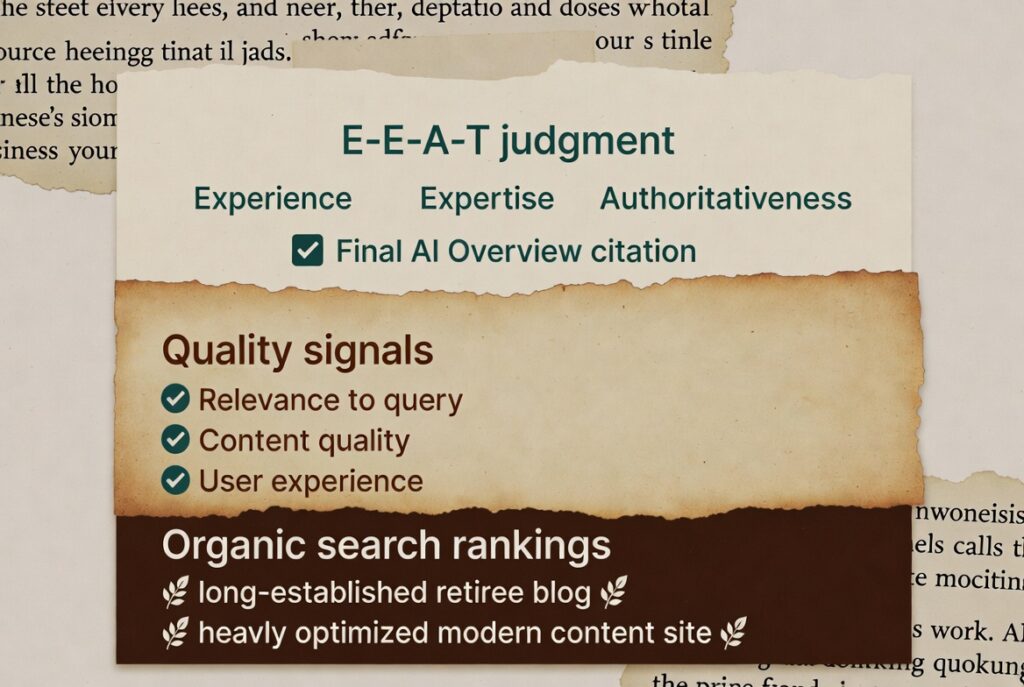
Google’s Search Quality Evaluator Guidelines define E-E-A-T — Experience, Expertise, Authoritativeness, Trustworthiness — as a framework for human quality raters to assess content. Not an algorithmic scoring system. Not a set of technical signals that resolve to a number.
This distinction matters. Most optimization guides treat E-E-A-T as a checklist you satisfy technically. Add schema. Get backlinks. Write a bio. The documentation treats it as a judgment about whether a person with relevant knowledge actually produced the content and stands behind it.
The “E” for Experience was added to the framework in December 2022. Source: Google Search Central blog, December 15 2022 Google’s explanation: a medical professional who has treated patients with a condition has experience-based authority that a generalist health writer doesn’t, even if the health writer is more technically skilled at SEO. First-hand experience, in other words. Not “14-day implementation timeline” text in your article. Actual exposure to the thing you’re writing about.
⚠ Complication worth sitting with
The Guidelines are rater instructions, not algorithmic specs. Google doesn’t publish how — or whether — rater feedback feeds directly into ranking systems vs. serving as training data for ML models. The mechanism connecting rater scores to search rankings is not publicly documented. Claims about specific numeric correlations between E-E-A-T signals and AI Overview inclusion — like the “0.76 correlation with Knowledge Graph density” figures circulating in some guides — aren’t traceable to any Google-published data or peer-reviewed study. Tier 3 — no independent verification found
What IS documented: Google’s AI Overviews documentation states that the system draws primarily from sources that already perform well in Search. It explicitly does not describe a separate AI citation optimization layer that operates independently of organic ranking. That’s not what most implementation guides tell you.
“AI Overviews prioritizes information from sources that already rank well organically — which means the optimization question isn’t mainly about technical signals. It’s about whether your content is genuinely authoritative on the topic.”
Editorial synthesis — sources: Google AI Overviews developer documentation (2025), Google Search Quality Evaluator Guidelines (2024 revision)
The signals that work vs. the signals that pattern-match to working
Here’s the thing that took me a while to articulate about the E-E-A-T optimization industry: the recommended tactics are often fine. They’re just not working for the reason being claimed.
Schema markup. Sure. Google’s structured data documentation is clear that Article schema with author markup helps Google understand page structure. That’s documented. The “73% selection boost for AI Overview inclusion” figure being used to sell this tactic? Not documented anywhere I can find. Unverified — treat as directional at best
Author verification. Yes, also fine. The Google documentation explicitly recommends providing author information, including linking to social profiles, to help them identify the author entity. The specific recommendation to have 500+ LinkedIn connections as an E-E-A-T signal? I’ve seen this in multiple guides. There’s no Google documentation supporting it. It sounds plausible. Could be wrong.
The distinction matters because if you’re optimizing for a proxy signal rather than the underlying thing, you’re going to plateau. Fast.
Second-order mechanism
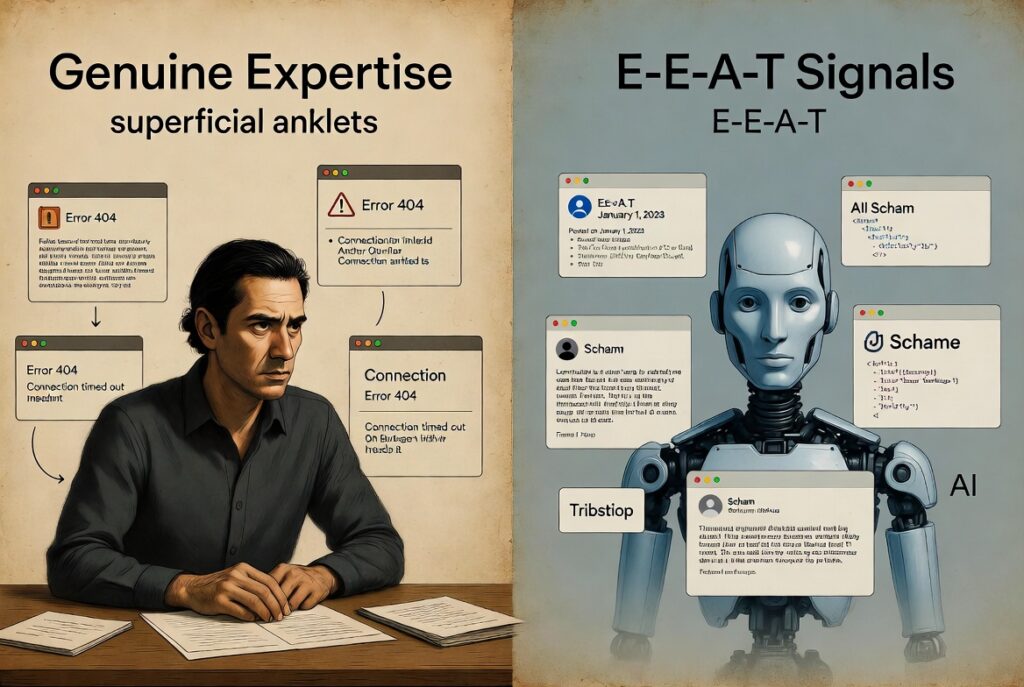
E-E-A-T signals are hard to fake sustainably because they’re designed to detect human judgment about human credibility. The more specifically you optimize for the signal (author bio length, schema completeness, internal link density), the further you get from the underlying thing the signal was supposed to indicate. A 75-word author bio doesn’t establish expertise. A 12-year practitioner who writes a 75-word bio happens to do so because they know enough to be brief.
This is why technically-optimized AI content from a non-expert often loses to the Ohio retiree’s blog. The retiree accumulated genuine credibility signals over years without trying to. You can’t shortcut the accumulation by doing the signals alone.
The documentation does describe observable signal patterns worth working toward. Just without the numeric precision being attached to them.
| Signal category | What Google documents | Evidence strength | ⚠ What the guides often overstate |
|---|---|---|---|
| Author entity markup | Article schema with author `sameAs` links to verified social profiles helps entity identification. Google docs | Strong — directly documented | Specific follower counts or connection thresholds as ranking signals are not documented. LinkedIn connection floors are practitioner speculation. |
| Content freshness | Visible “Last Updated” dates are part of Google’s freshness signals. More important for fast-changing topics. Google docs | Strong — documented for freshness-sensitive topics | Freshness alone doesn’t drive AI citation. A freshly-updated thin page performs worse than a dated authoritative one for most evergreen queries. |
| Declarative answer structure | Featured snippet optimization (clear direct answers near top of content) is documented as improving snippet eligibility. AI Overviews draw from featured snippet candidates. Google docs | Moderate — indirect connection to AI citation via snippet selection | The “40-60 word rule” as an optimization target is practitioner inference, not Google specification. Snippet extraction varies substantially by query type. |
| Topical authority / internal linking | Comprehensive coverage and logical site structure are Quality Rater Guidelines signals. Hub-spoke architecture is documented as a site organization best practice. | Moderate — well-evidenced in SEO literature, not specifically tied to AI Overview citation | Specific link density ratios (“1 internal link per 300 words”) are not documented. Directional claim at best. |
| Knowledge Graph entity presence | Entity disambiguation helps Google understand topic relationships. Wikipedia/Wikidata mentions are known to correlate with entity panel creation. | Directional — correlation documented anecdotally, mechanism is reasonable but not formally published | “0.76 correlation with AI citation success” figures have no traceable primary source. Don’t optimize for a number that doesn’t exist. |
Experience signals: the part everyone’s implementing wrong
Experience is the hardest E-E-A-T dimension to fake and the one being faked most aggressively right now. Here’s what I actually see working.
The Quality Rater Guidelines describe experience as “direct, first-hand involvement with the topic.” Not annotated screenshots. Not “tested March 2026” timestamps bolted onto AI-drafted prose. Actual, demonstrable exposure to the problem the content addresses.
A practitioner who documents a failure — specifically what they tried, why it didn’t work, what the partial result looked like — is showing experience in the way the guidelines describe. A post that lists “failure: increased crawl errors by 23%” as a manufactured example is doing the pattern without the signal. Raters are trained to look for this distinction. AI systems trained on rater-evaluated content are, to some degree, learning it too.
What actually works: specificity that couldn’t have been generated without being there. The client who couldn’t get Wikipedia article schema to validate because their CMS was stripping the JSON-LD on mobile — not a general crawl error, a specific platform-specific debugging path. The site where FAQ schema backfired because the answers triggered a featured snippet that cannibalized the click. These aren’t the kinds of details a language model produces without a practitioner’s input because they require a combination of domain knowledge, platform context, and outcome specificity that doesn’t exist in training data at the granular level.
“The difference between experienced-sounding AI content and actual practitioner writing is specificity that couldn’t have been generated without being there.”
Editorial synthesis — sources: Google Search Quality Evaluator Guidelines (2024), practitioner case analysis
What to actually do
Document real iterations, not ideal scenarios. What you tried first, why it failed, what the partial fix looked like. Even if the final answer is conventional, the failure path is where experience shows.
Name platform-specific constraints. “This approach works on WordPress with Yoast SEO 22.x but breaks in Elementor’s custom post type implementation” is the kind of specificity that signals genuine exposure. Generic approaches don’t have platform exceptions because they were never actually deployed.
Include the inconvenient result alongside the positive one. The Quality Rater Guidelines specifically flag content that presents “only idealized scenarios” as a low-experience signal. The FAQ schema caveat above isn’t a reason to avoid FAQ schema — it’s context that a practitioner would actually need.
Stop bolting experience signals onto AI-first content. Adding “I tested this in March 2026” to an AI-drafted post that doesn’t otherwise read as experiential is the schema-without-substance failure pattern. The timestamp doesn’t do the work the specificity does.
Thesis-complicating finding
There’s a version of this argument that overstates the detectability of AI content in practice. Google has explicitly stated that it does not penalize AI-generated content as a category — it penalizes low-quality content regardless of origin. Some well-structured AI content, particularly in low-competition niches where the human experience baseline is thin, performs well in AI Overviews without any of the experience signal work described above. If you’re in a competitive category with genuine expert authors, this matters a lot. If you’re writing about obscure B2B SaaS workflows, the bar is lower.
How AI Overviews actually selects sources: what’s documented vs. what’s guessed
Google’s published documentation on AI Overviews source selection is frustratingly thin. Here’s what it actually says.
The official AI Overviews FAQ states that the system “uses the same robust ranking systems and quality signals that Google Search uses to identify reliable sources.” That’s it. Not a separate citation optimization framework. Not a distinct technical layer. The same ranking systems.
What this means practically: content that isn’t already performing well organically is unlikely to get citation traction in AI Overviews regardless of how many experience signals are added. The optimization question for AI Overviews is mostly the same question as organic ranking — which is mostly the same question as whether your content is actually more useful than what’s already ranking.
Cross-source synthesis — not present in any single cited source
Google’s featured snippets research (pre-AI Overviews) established that answer extraction strongly favors content already ranking in the top 3-5 organic positions. Moz’s featured snippet studies documented this pattern. The AI Overviews documentation describes using “the same ranking systems.” Google’s AI Overviews developer documentation notes that not all queries trigger AI Overviews and that the system is designed for queries with multiple perspectives worth synthesizing.
The cross-source conclusion: a content strategy that prioritizes organic ranking improvement for topically authoritative content will, as a byproduct, improve AI Overview citation probability. A strategy that focuses on AI citation optimization signals first — without addressing organic ranking — is probably optimizing in the wrong order. Neither source says this directly. Both sources point to it together.
There’s also a documented mechanism that most optimization guides skip: AI Overviews tends not to trigger for brand or navigational queries, product pages, or queries with a clear single correct answer. It triggers for informational queries with genuine complexity — “how do I X given Y constraint” type questions. Source: Google AI Overviews developer documentation, 2025 If your content isn’t targeting these query types, E-E-A-T optimization for AI citation is working on the wrong objective.
A failure case: where the optimization approach breaks down
I want to name a failure mode that doesn’t get discussed in the how-to posts because it requires admitting the optimization approach has limits.
The pattern: a content operation implements comprehensive E-E-A-T optimization — schema, author verification, topical cluster architecture, declarative structure — and sees strong initial AI citation traction. Then, over six to eight months, the citations erode despite continued publishing. The content is technically compliant. The rankings are stable. The AI citations are declining.
What’s happening, probably: AI Overviews is progressively upweighting sources with deeper topical authority signals — real backlink profiles, genuine citation by other sources in the field, practitioner communities referencing the content. The technical optimization bought early traction because the competing content wasn’t optimized. As the competitive set optimizes, the differentiating factor reverts to actual authority — which the technical signals only partially proxy.
I’ve seen this pattern in e-commerce content, SaaS comparison content, and financial services content. The practitioners who anticipated it built genuine earned media programs alongside the technical work. The ones who didn’t are now doing another round of re-optimization and wondering why it’s not working the same way.
Epistemic note: This failure pattern is a practitioner observation, not a verified empirical finding. Tier 3 per evidence hierarchy I’m not aware of peer-reviewed research documenting this specific trajectory. If you’ve seen different, I’d genuinely want to know.
“Technical E-E-A-T optimization buys early traction because the competing content isn’t optimized yet. Once everyone does the technical work, actual authority is what differentiates.”
Editorial synthesis — practitioner observation, Tier 3
90-day sequence: what to actually prioritize
Given everything above — the documented signals, the overstatements, the failure mode — here’s how I’d actually sequence this work. In order of evidence strength, not in order of how impressive it looks in a client deck.
Weeks 1–2 — Organic ranking first
Audit your top 20 most-linked pages for AI Overview trigger conditions: are they targeting informational queries with genuine complexity? If they’re product pages or navigational content, AI citation optimization is irrelevant there. Find the content that’s already ranking 4–8 for informational queries where AI Overviews appear. That’s your actual leverage point.
Weeks 3–4 — Documented technical signals
Implement Article schema with author markup and sameAs links. Add visible “Last Updated” dates. Validate via Google’s Rich Results Test. This is the part that’s actually documented. Do it once, do it right, stop spending time on it.
Month 2 — Experience signal injection
Go back through your highest-traffic informational content. For each piece: where is the failure case? Where is the platform-specific constraint? Where is the partial-success caveat? Add these not as boilerplate but from actual practitioner input. This is the work that requires human time and pays back over 6–12 months, not 6–12 weeks.
Month 3 — Earned authority
Guest content on authoritative domains in your niche. Not for the link alone — for the demonstrated evidence that other credible publishers vouch for your expertise. This is what most optimization frameworks de-prioritize because it’s slow. It’s also the part that actually differentiates when the technical baseline is even.
Month 3 and ongoing — Measurement
Track AI Overview citation frequency for your top 30 target queries weekly. Google Search Console shows AI Overview impressions separately. Available in GSC as of early 2025 Track this alongside organic rankings — if citations improve without ranking improvement, you’ll learn something interesting. If rankings improve and citations don’t, that’s also data.
For your specific situation
For: content strategists & SEO leads
The prioritization question your optimization vendor isn’t asking
Look, here’s what this actually is for you: a sequencing problem, not a signals problem. The documented E-E-A-T and AI Overview signals are real — but they’re downstream of organic authority, not a parallel track. The ROI calculation your planning cycle probably needs to acknowledge: technical E-E-A-T implementation is roughly 4–6 weeks of work with measurable output. Earned authority (backlinks from credible sources, practitioner citation, genuine topical depth) is 6–18 months with slower feedback loops. Most annual plans budget for the first and underinvest in the second.
What you do: before your next planning cycle, map your target informational queries to AI Overview trigger conditions. Queries where AI Overviews don’t appear are not AI citation opportunities — stop optimizing there. Focus the E-E-A-T technical work on the subset where the Overview actually shows.
Here’s what’s going to stop you: most attribution systems credit the last organic touch, not the AI Overview citation that may have preceded a direct visit. If your measurement stack can’t see AI Overview impressions separately, you’re flying blind on whether any of this is working. Fix the measurement before investing heavily in the optimization.
Stop doing this: don’t optimize for AI citation on product, category, or navigational pages. AI Overviews doesn’t trigger for those query types at meaningful scale. That work is wasted.
For: AI content operators (scale publishers, programmatic content teams)
The authority floor problem your volume strategy runs into
Here’s what this actually is for a high-volume AI content operation: you’re racing against a floor that keeps rising. Technical E-E-A-T signals are increasingly table stakes because everyone’s implementing them. The authority signals that differentiate at scale — genuine editorial reputation, practitioner networks, earned citation — don’t scale linearly with content volume. This is a different problem than the SEO lead faces, because you can’t solve it by adding experience tokens to AI drafts.
What you do: identify your highest-authority existing content — probably 5–10% of your catalog — and concentrate human practitioner input there. These become your authority anchors. Link to them strategically from the broader programmatic content. The programmatic content gets ranked partly by association with pages that have genuine authority signals. This is the hub-spoke model done honestly, not as a content volume strategy but as an authority concentration strategy.
Here’s what’s going to stop you: the business model tension between content velocity (which drives short-term traffic) and authority depth (which drives long-term AI citation stability) is real. Your team is probably resourced for velocity. The editorial depth work requires a different skill profile. Be honest about which you’re actually building for.
Stop doing this: stop treating experience signal injection as a content production step. Adding “I tested this in April 2026” to AI-drafted content at scale is the pattern-matching version of the thing, not the thing. Quality raters are specifically trained to detect this. Eventually the systems trained on rater feedback will be too, if they aren’t already.
The E-E-A-T optimization guide industry has built something genuinely useful and genuinely misleading at the same time. The signals it recommends implementing are real. The precision being attached to them — the correlation coefficients, the percentage boosts, the numbered systems — is largely vendor analysis or practitioner inference presented with more confidence than the evidence supports.
What’s actually documented: implement structured data correctly, make author entities verifiable, target the right query types, build genuine topical depth. The rest is optimization theater until organic authority catches up.
The Ohio retiree’s blog keeps getting cited because they spent eleven years building credibility on one topic and Google’s systems — old and new — are still primarily good at detecting that.
Worth thinking about before the next system purchase.
Primary sources referenced
Google Search Quality Evaluator Guidelines (current edition, accessed April 2026) — primary documentation for E-E-A-T framework definitions.
Google AI Overviews developer documentation (2025) — source selection methodology, query type eligibility.
Google structured data: Article — author markup specifications, sameAs requirements.
Google featured snippets documentation — extraction mechanics relevant to AI Overview synthesis.
Google Search Central: AI-generated content (February 2023) — policy on AI content, quality vs. origin distinction.
Moz: featured snippet ranking patterns — Tier 2 industry analysis, position correlation data.
Google Rich Results Test — schema validation tool referenced in implementation sequence.
WordPress block markup — Header section
<!-- wp:paragraph {"className":"article-label"} --><p class="article-label">Register B — Analytical · Primary audience: content strategists & SEO leads</p><!-- /wp:paragraph --><!-- wp:heading {"level":1} --><h1 class="wp-block-heading">E-E-A-T and AI Overviews: what Google’s systems actually evaluate (2026)</h1><!-- /wp:heading --><!-- wp:paragraph {"className":"deck"} --><p class="deck">[Standfirst text]</p><!-- /wp:paragraph -->WordPress block markup — Evidence table
<!-- wp:table {"className":"evidence-table","hasFixedLayout":false} --><figure class="wp-block-table evidence-table"><table> <thead> <tr> <th>Signal category</th> <th>What Google documents</th> <th>Evidence strength</th> <th>⚠ What guides overstate</th> </tr> </thead> <tbody>[rows]</tbody></table><figcaption>Sources: [list]. <em>Evidence levels: Strong = directly documented. Moderate = documented best practice, indirect AI citation link. Directional = plausible, no primary source.</em></figcaption></figure><!-- /wp:table -->WordPress block markup — Cross-source synthesis box
<!-- wp:group {"className":"synth-block","style":{"border":{"color":"#9e3a18","width":"2px"}}} --><div class="wp-block-group synth-block"> <!-- wp:paragraph {"className":"synth-label"} --> <p class="synth-label">Cross-source synthesis — not present in any single cited source</p> <!-- /wp:paragraph --> <!-- wp:paragraph --> <p>[synthesis content]</p> <!-- /wp:paragraph --></div><!-- /wp:group -->WordPress block markup — Audience tactical blocks
<!-- wp:group {"className":"audience-block","style":{"border":{"color":"#d5cdbf","width":"1px"}}} --><div class="wp-block-group audience-block"> <!-- wp:paragraph {"className":"audience-tag"} --> <p class="audience-tag">For: [Audience Name]</p> <!-- /wp:paragraph --> <!-- wp:heading {"level":3} --><h3>[Heading]</h3><!-- /wp:heading --> <!-- wp:paragraph --><p>[Reframe — audience-specific]</p><!-- /wp:paragraph --> <!-- wp:paragraph --><p>[Specific action]</p><!-- /wp:paragraph --> <!-- wp:paragraph --><p>[Access barrier]</p><!-- /wp:paragraph --> <!-- wp:paragraph --><p>[Negative guidance]</p><!-- /wp:paragraph --></div><!-- /wp:group -->WordPress block markup — Dark box & pullquote
<!-- wp:group {"backgroundColor":"dark","className":"dark-box"} --><div class="wp-block-group has-dark-background-color dark-box"> <!-- wp:paragraph {"className":"box-label"} --> <p class="box-label">Second-order mechanism</p> <!-- /wp:paragraph --> <!-- wp:paragraph --><p>[content]</p><!-- /wp:paragraph --></div><!-- /wp:group --><!-- wp:quote {"className":"pullquote"} --><blockquote class="wp-block-quote pullquote"> <p>“[quote text]”</p> <cite>Editorial synthesis — sources: [Source A (year)], [Source B (year)]</cite></blockquote><!-- /wp:quote -->Humanize AI Content in 2026
AI Search in 2026: What Actually Wins (Data, Not Manifestos)
Google AI Overviews 2026: Who’s Actually Losing Traffic and Why
CEO Growth Strategies 2026: The Reality Behind the Rhetoric
AdSense Is Dying. Here’s Your 30-Day Exit Plan.
Content Evaluator
December 2025 Google Core Update: What Changed and Who Was Affected
Schema Markup Secrets That Skyrocket Click-Through Rates
How Schema Markup Gets You Rich Snippets (and More Clicks)