
By [Tom Morhgan], [credential/role — “SEO strategist, 8 years in technical search”]. Last updated: September 2026. Sources verified at time of publication; see maintenance notes below.
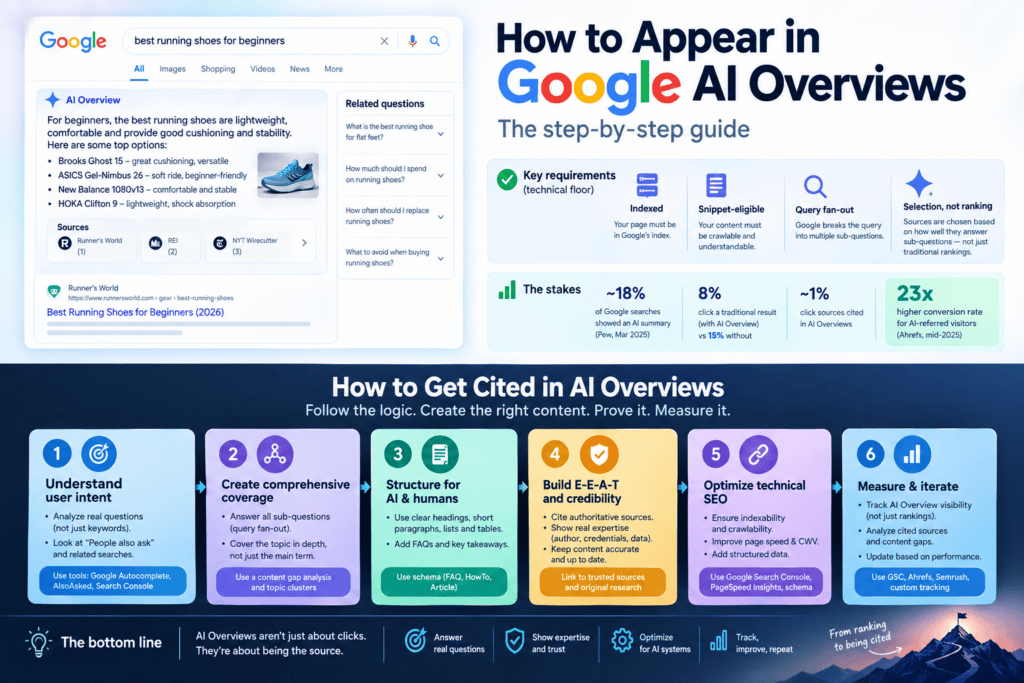
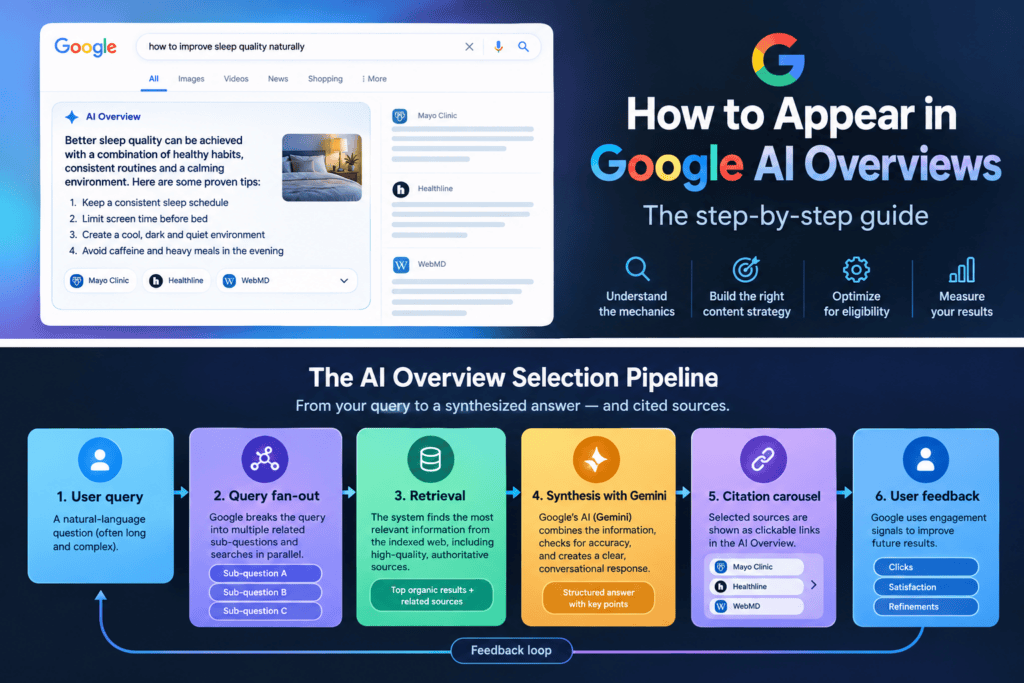
Google’s AI Overviews draw from the same index as classic Search, and Google states there is no special markup required to appear in them. But eligibility has a hard technical floor — a page must be indexed and snippet-eligible — and selection runs on query fan-out: Google’s system decomposes each query into sub-questions and cites pages that answer those sub-questions, not simply pages that rank #1 for the head term.
A page can hold position one in Google and be effectively invisible. When an AI Overview sits above the organic results and answers the query before a single blue link gets a glance — the feature Google launched to all U.S. users on May 14, 2024, and has since expanded to well over 100 countries — the sources cited inside that synthesized answer are chosen by a mechanism that has almost nothing to do with the ranking-factor lists most SEOs carry around in their heads.
If your page isn’t cited, you lose twice: once to users who read the summary and stop, and once to users who click but click a cited competitor. For informational queries, appearing in AI Overviews is the visibility contest that matters — and it is played by learnable rules. This guide walks through them in order: eligibility, selection mechanics, coverage strategy, then measurement.
The stakes, in brief. In Pew Research Center’s panel analysis of 900 U.S. adults (March 2025), roughly 18% of Google searches produced an AI summary. When one appeared, users clicked a traditional result 8% of the time versus 15% without one, and links cited inside summaries were clicked in about 1% of visits. Google disputes the methodology. But the value case no longer rests on clicks alone: Ahrefs reported in mid-2025 that AI-referred visitors converted at roughly 23x the rate of traditional organic visitors in its funnel (0.5% of traffic produced 12.1% of signups). Plan for citation value, not just raw clicks.
How AI Overviews actually choose their sources
Google’s documentation describes AI Overviews and AI Mode as using a query fan-out approach: while a response is being generated, the system may issue multiple related searches across subtopics rather than relying on a single keyword match.
Three properties of this pipeline matter for optimization.
Selection is passage-level, not page-level. A 4,000-word guide does not get cited as a unit. The system retrieves and grounds specific passages that answer specific sub-questions — which is why a tightly focused 800-word page can out-cite a sprawling pillar page.
Fan-out rewards coverage, not head-term rank. Because the system issues several related sub-queries as the answer forms, a page that answers sub-question B can be cited even if it ranks on page two for the original query. The evidence has strengthened quickly. Ahrefs’ mid-2025 analysis of 1.9 million citations found 76% of cited pages ranked in the top 10. By 2026, cross-methodology measurement — first reported by ALM Corp in March 2026, then confirmed on Ahrefs’ own updated dataset in May 2026 — put the figure at roughly 38%, with about 31% of citations going to pages ranking 11–100 and another 31% to pages outside the top 100 entirely.
Two readings are possible here. Either retrieval is reaching deeper because fan-out pulls from sub-query SERPs where different pages lead, or Google is deliberately diversifying citations. Either way, head-term position is losing its grip on citation share, and coverage across the topic cluster is gaining it. That does not mean rankings stopped mattering, though. In Cyrus Shepard’s May 2026 Zyppy meta-analysis of 54 experiments across ChatGPT, Gemini, and Perplexity, the top five evidence-weighted factors were URL accessibility (9.5/10), search rank (9.4), fan-out rank across sub-queries (9.3), preview-control compliance (9.2), and query-answer match (9.2).
One scope caveat: that meta-analysis measures AI-search systems broadly, not Google AI Overviews in isolation. Treat its scores as strong cross-system priors about how retrieval-based AI answers select sources, not as a Google-specific formula. The right mental model is multiplicative: rank gets you retrieved, coverage gets you cited for queries you don’t rank for, and passage craft (Step 3 below) decides which page the model grounds its answer in when several pages qualify.
Feedback compounds. Google has stated that user behavior influences the system over time — if users consistently click one cited source, or ignore the Overview and click a particular result instead, that signal feeds back into future answers. Early citation wins are self-reinforcing, which is why first-mover advantage on fan-out coverage is real.
One calibration before the steps: an AI Overview is not a featured snippet. A snippet extracts one passage from one page. An Overview synthesizes an original answer from multiple sources and attaches citations afterward. Tactics built for winning snippets — exact-match 40-word definitional blocks — still don’t hurt, but they’re aimed at a mechanism that mostly isn’t running here.
Step 1: Pass the eligibility gate
Google’s official position is that there are no special technical requirements for AI Overviews. That’s true, and it’s incomplete. The actual eligibility rule, buried in the same documentation: to appear as a supporting link in AI Overviews or AI Mode, a page must be indexed and must be eligible to appear in Google Search with a snippet.
That second condition has teeth. The nosnippet robots meta tag, max-snippet:0, or an X-Robots-Tag: nosnippet header makes a page ineligible — not just for the snippet under your listing, but for AI Overviews and AI Mode entirely. These directives are usually fossils: leftovers from 2018-era advice about hiding pricing or “protecting” content from scrapers. They sit quietly in page headers or CDN rules, and when AI Overviews launched, the pages carrying them silently dropped out of citation eligibility with no obvious symptom in Search Console.
SEO consultant Glenn Gabe documented the mechanism working in both directions: he added nosnippet to a post that was being cited, watched it drop out of the AI Overview within hours, then — after a reappearance glitch that Google’s John Mueller attributed to reprocessing delay — saw the citation card fully removed. The experiment also showed the cost: the normal search listing lost its descriptive snippet too, likely depressing its regular click-through rate.
Run this audit before anything else:
- Crawl your site (Screaming Frog, Sitebulb, or a server-side grep) for
nosnippet,max-snippet:0, andX-Robots-Tagconfigurations — including CDN/WAF layers, where header rules often hide. - Check
robots.txtforGoogle-Extended. This is the most widespread misunderstanding in the space.Google-Extendedcontrols whether your content trains or grounds Gemini. It does not affect inclusion in Search, and it does not remove you from AI Overviews. Sites have blocked it believing it was an AI Overview opt-out and lost nothing except Gemini-app visibility. - Confirm indexation and snippet status for the pages you care about. If a strategically important page is
noindex-ed, blocked, or orphaned, fix that first — none of the later steps work on a page Google can’t serve with a snippet. - Fix structured data to match visible content. Not because schema buys AI citations directly, but because mismatched markup undermines the entity understanding the whole pipeline depends on.
| Control | What it does | AI Overview effect | The catch |
|---|---|---|---|
nosnippet / max-snippet:0 | Removes or zeroes your snippet everywhere | Removes AI Overview / AI Mode eligibility | Also kills your normal SERP snippet — usually a net traffic loss |
max-snippet:[n] | Caps snippet length | Restricts how much can be previewed and cited | Blunt instrument; same global side effects |
data-nosnippet (HTML attribute) | Excludes a specific passage | Fences off only the marked section | The surgical tool — right for pricing blocks or passages that misread out of context |
noindex / blocking Googlebot | Removes page from Search | Removes you from everything | A wall, not a scalpel; almost never the right trade |
Google-Extended (robots.txt token) | Excludes content from Gemini training/grounding | None — Search inclusion unaffected | Solves a different problem than most publishers think |
The general rule: more restrictive permissions limit how your content is featured across Google’s AI experiences, and you can’t selectively restrict AI features without touching classic Search. Google said in January 2026 it is exploring dedicated opt-out controls that would avoid fragmenting Search, but gave no timeline — watch it, don’t plan around it.
Step 2: Audit your fan-out coverage
Here’s the strategic core of this guide. Because selection runs on query fan-out, the right target isn’t “rank for keyword X.” It’s “answer the set of sub-questions Google’s system generates from X.”
Google doesn’t publish those sub-questions, but it effectively leaks them. The Gemini API with Google Search grounding — the same model family that powers AI Overviews and AI Mode — returns groundingMetadata.webSearchQueries, the list of search queries the model issued to ground its answer. SEO agency Go Fish Digital published a reproducible workflow combining Screaming Frog’s custom JavaScript extraction with the Gemini API: feed a page’s H1, or your target query, to the model with search grounding enabled, and read back both the generated answer and the fan-out query list.
Budget realistically: a half-day to a day for the first run (API setup is quick, but wiring the extraction into a crawler and cleaning the output takes longer than most posts suggest). After that, re-running the audit on new seeds is an afternoon’s work.
One honest caveat, stated plainly: the API’s query list simulates fan-out behavior — it isn’t a transcript of production retrieval. Google doesn’t guarantee the AI Overview system issues the same sub-queries in the same order. The method is the best available proxy — it reveals the shape of your coverage gaps and is corroborated by the citation-rank trend above — but treat its output as a prioritized hypothesis list, not ground truth, and validate the top gaps manually.
Run this as a five-part audit:
- Pick 10–25 seed queries that matter commercially — full natural-language questions your buyers actually ask, not head-term keywords. Pew’s March 2025 data shows why phrasing matters: question-form searches triggered AI summaries 60% of the time in their sample, versus 36% for full-sentence searches, 53% for queries of ten-plus words, and just 8% for one- or two-word queries.
- Collect the fan-out queries each seed generates. Expect a handful per seed — definitional, comparative, cost-related, step-related, risk-related.
- Map coverage. For each sub-question, does a page on your site answer it directly, in crawlable text, as a self-contained passage? Be strict — “we mention it in passing” is a miss.
- Close the gaps deliberately. Each uncovered sub-question becomes a new section or a new page. Prioritize by commercial weight and by how often it recurs across seeds — recurring sub-questions are your topic’s connective tissue and the highest-leverage gaps.
- Re-run quarterly. Fan-out behavior shifts every time Google swaps the underlying model, and the cadence is faster than most publishers assume: a customized Gemini 1.5 Pro-based model at launch (May 2024), Gemini 2.0 (March 2025), a customized Gemini 2.5 (May 2025), and Gemini 3 as the new default (January 27, 2026). Each generation decomposes queries differently, and the Gemini 3 rollout appears to have made retrieval even more rank-agnostic — another reason not to let an audit age.
Read the matrix the way the machine would. Your page covers cost and the spreadsheet comparison — both cited. It says nothing about implementation time, integrations, or migration risk — three sub-questions where competitors get the citations instead. You don’t need to beat Competitor A on everything. You need to stop leaving whole sub-questions unanswered, because each one is a citation slot handed to someone else.
Step 3: Write for extraction
Coverage gets you into the retrieval set. Passage craft determines whether you’re the page that gets grounded.
Be the source whose information density exceeds what a summary can carry. Pew’s March 2025 data showed the median AI summary ran 67 words (range: 7 to 369). That length handles definitions and overviews well. It handles current prices, exact specifications, step-by-step procedures, and original data poorly. Concrete numbers, dated statistics, tables, and first-hand documentation are exactly the material a 67-word synthesis must cite rather than absorb — and the material a user must click through to get. This is the durable answer to “how do I get the click back”: you’re not trying to beat the summary, you’re trying to be un-summarizable.
Build the off-site brand signals the system tracks. Ahrefs’ study of 75,000 brands found branded web mentions correlated with AI Overview visibility at 0.664 — roughly three times more strongly than backlinks (0.218). Citations are partly an entity decision, and entities are built by being talked about, not just linked to. This is the least page-shaped advice here, and possibly the highest-leverage: original research, quotable data, and PR that gets your brand named where your buyers actually ask questions.
Answer sub-questions in self-contained blocks. Each section from Step 2 should open with a direct, two-to-three-sentence answer that stands alone when lifted out of context. Supporting detail follows. A passage that only makes sense after three paragraphs of setup makes poor grounding material.
Use question-shaped headings for question-shaped queries. Since natural-language and question-form queries are most likely to trigger Overviews, headings that mirror the sub-question phrasing — “How long does CRM implementation take?” — align your passages with fan-out’s retrieval patterns.
Keep key content in crawlable HTML. Content locked inside scripts, iframes, or images contributes nothing to retrieval. Supporting media still helps overall page quality, but the passages that get cited are textual.
Refresh relentlessly, and prove it. Retrieval favors fresh index data over model memory. Across large-scale citation analysis, AI-cited content averages roughly 25% fresher than organic top-10 results, and third-party bot logs show most AI-crawler hits landing on content less than a year old. Pages with visible “last updated” discipline and genuinely current figures get re-crawled and re-cited. Pages quietly going stale get quoted with last year’s numbers, or dropped for a fresher source.
Two things not to do: don’t manufacture “AI-ready” schema — Google has repeatedly said no special markup exists, and shortcuts here are a dead end. And don’t sand your conclusions down into consensus mush — synthesized answers cite sources that make clear, checkable claims, not pages that hedge everything.
Step 4: Fix measurement yourself
Google lumps AI-feature traffic into the general “Web” search type in Search Console, with no filter for AI Overviews. Google’s stated reasoning is that AI features “are a part of Google Search” — technically defensible, practically useless for attribution. Google tested a featured-snippet filter back in 2016 and never shipped it; don’t expect an AI Overview filter soon.
Until one exists, build the loop manually:
- Sample your priority queries weekly. Run your 25 seed queries (signed in, from your target market) and record whether an Overview appears, whether you’re cited, and which competitors appear. A spreadsheet beats nothing; several third-party tools now automate this.
- Watch for the signature pattern in Search Console: pages with high impressions, strong average position, and very low click-through rate. That combination often means an Overview is answering the query in place — sometimes using your content. When you see it on a money page, that query jumps to the top of your fan-out audit list.
- Rebalance metrics toward outcomes, not clicks. This point conveniently absolves Google of the traffic decline, but it holds real weight: the 23x AI-referral conversion premium mentioned earlier, combined with Google’s claim that AI features increase total query volume (Sundar Pichai has cited “over 10% more queries globally” for the query types that show them — a first-party claim, not independently verified). The rational model: fewer clicks per search, but more searches and higher intent per surviving click. Track conversions, signups, and branded search volume alongside organic clicks.
The evidence conflict deserves a straight statement, not a shrug. Pew’s panel data says clicks fall sharply when summaries appear. Google says the methodology is flawed and it sees no significant aggregate traffic drop. Both can be partially right — Pew’s sample is U.S. panel data from March 2025, not global production traffic, and Google hasn’t shared filtered data that would settle it. What’s not in dispute: Pew found roughly two-thirds of searches in its sample ended with no click at all. Plan on informational-query traffic continuing to compress while citation visibility becomes a measurable asset in its own right.
Where this breaks down
Transactional and navigational queries barely trigger Overviews. Third-party 2025 measurements found branded queries trigger AI summaries under 5% of the time, and effectively never for purely navigational queries. Treat these as directional — they come from third-party sampling with their own blind spots, and late-2025 data showed Google quietly testing Overviews on a growing share of navigational queries. If your business lives on “buy X” and “brand login,” this optimization is close to irrelevant for now — but monitor your brand terms rather than assuming the exemption lasts.
AI Mode is a different system with different citations — for now. Ahrefs’ December 2025 analysis found only ~14% URL overlap (13.7%, precisely) between AI Overview and AI Mode citations for identical queries, despite both being Google products built on the same Gemini family. That’s a single measurement from a fast-moving system. Practical posture: optimize for Overviews as the primary target, spot-check AI Mode on your seed queries as part of the weekly loop, and be ready to promote it to a first-class target if overlap climbs in future measurements.
YMYL topics face stricter sourcing. Health, finance, and legal queries get elevated quality thresholds. Government sites were over-represented in Pew’s citation data (6% of AI summary links versus 2% of standard results) — a useful hint about which authority signals the system leans on when the stakes are high.
Small and new sites face a real cold-start problem. The most-cited domains in Pew’s sample — Wikipedia, YouTube, Reddit, together 15% of summary links — are exactly the high-authority properties a conservative retrieval system would prefer. Fan-out’s diversity opens side doors (recall: 62% of citations now go to pages outside the top 10), but authority still compounds — the feedback loop rewards sources users already trust, and the brand-mention correlation favors brands already talked about. If your domain is young, expect citations to lag content quality by quarters, not weeks. Invest in the signals that raise your retrieval ceiling: mentions, citations, links, and YouTube presence.
The whole system moves faster than the folklore says. The model underneath AI Overviews has changed three times in roughly 20 months: 1.5 Pro at launch, 2.0 in March 2025, 2.5 by May 2025, Gemini 3 as the default from January 27, 2026. Each swap changes decomposition behavior, trigger rates, and citation patterns, and the Gemini 3 transition appears to have pushed retrieval further beyond the top 10. Every recommendation here is a statement about the current system, not a law of physics — re-run your audits after each major model transition, not on an annual schedule.
Frequently asked questions
Do I need special schema markup to appear in AI Overviews?
No. Google has stated repeatedly that no dedicated schema or markup guarantees inclusion. Structured data still matters indirectly — it helps Google understand your entities and content accurately, which supports the fundamentals the whole pipeline runs on.
Does blocking Google-Extended remove me from AI Overviews?
No. Google-Extended In robots.txt, it only controls whether your content is used to train or ground Gemini models. It does not affect standard Search inclusion or AI Overview eligibility — that’s controlled separately, by nosnippet and related directives.
Why does Search Console show deep impressions but almost no clicks on a page I know performs well?
That pattern — high impressions, strong average position, very low CTR — commonly means an AI Overview is answering the query directly on the results page, sometimes citing your own content. It’s a signal to prioritize that query in your fan-out coverage audit, not a ranking problem to fix.
Can a page rank on page two and still get cited in an AI Overview?
Yes. Because fan-out issues multiple sub-queries and gathers sources for each, a page that thoroughly answers one sub-question can be cited even without a top-10 position on the head term. Recent measurement puts roughly 62% of AI Overview citations on pages outside the traditional top 10.
How often should I re-run a fan-out coverage audit?
Quarterly at minimum, and immediately after any major Gemini model transition in Search — the swap cadence has been roughly twice a year, not once, so an annual schedule will leave you working from stale sub-question data for months at a time.
The checklist, in order
- Eligibility audit — remove legacy
nosnippet/max-snippet:0Confirm crawlability, indexation, snippet eligibility; fix structured data mismatches. Nothing else works until this passes. - Fan-out audit — extract the sub-questions your 10–25 money queries generate via the API proxy; map your coverage; close the gaps as new sections or pages. Treat the output as a prioritized hypothesis list, not ground truth.
- Extraction rewrite — every target section opens with a self-contained direct answer; key facts live in crawlable HTML; information density the summary can’t absorb; freshness that’s visible and real.
- Off-site entity building — branded mentions, original research, PR, and YouTube presence: the strongest non-page correlate of citation.
- Measurement loop — weekly citation sampling on priority queries (with an AI Mode spot-check), the impressions-high/clicks-low pattern check in Search Console, and outcome metrics beyond clicks.
- Re-run quarterly, and immediately after any major Gemini model change in Search.
The publishers who come out ahead won’t be the ones who found a magic AI schema — it doesn’t exist, and anyone selling you one is selling fog. They’ll be the ones who treated the eligibility floor as a hard gate, the fan-out as the real battlefield, citation presence as a metric worth building infrastructure for, and the brand behind the page as part of the asset. The steps above are that infrastructure.
Meta description (155 chars): How to get cited in Google AI Overviews: the no-snippet trap, query fan-out audits, passage optimization, and measuring citations Search Console can’t show.
URL slug: /google-ai-overviews-optimization/
Suggested schema: TechArticle (with Article fallback) + FAQPage for the FAQ section above.
Internal links: pair this with your technical SEO audit checklist before the content work begins · for the refresh discipline in Step 3, see the content refresh framework.
External authority links:
- Google Search Central — AI features and your website
- Google, May 14, 2024 — Generative AI in Search
- Google, January 27, 2026 — AI Mode in Google Search and AI Overviews get Gemini upgrades
- Pew Research Center, July 22, 2025 — Do people click on links in Google AI summaries?
- Ahrefs, May 2026 — Updated: 38% of AI Overview citations pull from the top 10 (with the mid-2025 baseline)
- ALM Corp, March 2026 — cross-methodology analysis first reporting the 76% → 38% citation-rank shift
- Search Engine Land — What is query fan-out & how does it work for AI searches?
- GSQI (Glenn Gabe) — Using preview controls to remove content from AI Overviews
Editorial note (internal — remove before publishing to WordPress): sources verified include a live check that Gemini 3 became the default AI Overviews model on January 27, 2026, confirmed across Search Engine Journal, Engadget, 9to5Google, and Google’s own blog post. Highest re-verification risk going forward: (1) the next Gemini model swap in Search, (2) the 76%→38% citation-rank trend — re-check quarterly against Ahrefs/ALM Corp, (3) AI Mode overlap (currently 13.7%, one data point), (4) Google’s opt-out control exploration, (5) Pew/Google’s dueling click-rate figures. Recommended re-check: quarterly for stats, immediately after any Search/Gemini announcement.