
Technical SEO · Indexing
Instant URL Submission: The Protocol Google Won’t Join (And Doesn’t Need To)
IndexNow pushes a notification to four major search engines the second you hit publish. Google isn’t one of them — on purpose, and by Google’s own admission. Here’s what that protocol is quietly doing for your traffic in 2026, and where the line actually sits.
In March, I told a client that flipping on instant URL submission would get their new product page into Google within the hour. Nine days later, Search Console still showed Discovered – currently not indexed. The launch-week traffic we’d built the whole campaign around never arrived.
The ping itself worked exactly as designed. Bing had the page indexed in under four minutes — I checked, because I didn’t believe it either. Yandex picked it up the same day. Google, the search engine that sent this client roughly 70% of their organic traffic, never acknowledged the ping existed. Because it doesn’t. That’s not a setup error. It’s the entire shape of the protocol, and almost nobody explains that part before selling it.
What follows is what I wish someone had told me before that launch: what instant URL submission actually reaches, why that’s become more valuable in 2026 than it was when the protocol launched, and exactly where the gap is that no plugin closes.
One Ping, Four Doors — None of Them Marked Google
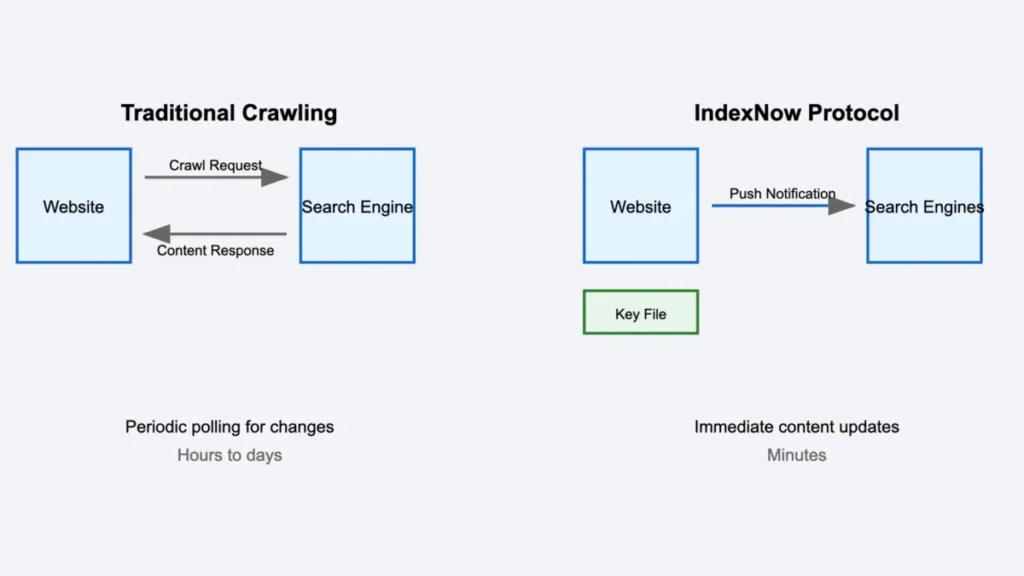
IndexNow is a single HTTP request. You send a URL — or up to 10,000 of them in one batch — along with a key that proves you own the domain, to api.indexnow.org. The protocol, opened by Microsoft and Yandex in October 2021, fans that notification out to every participating engine at once: Bing, Yandex, Naver, Seznam.cz, and a handful of smaller regional engines that have since joined.
What you don’t get, in this single request, is a line to Google. As of early-to-mid 2026, Google has still not adopted IndexNow, despite having said back in 2021 that it was “testing the potential benefits of the protocol.” Google maintains its own crawl-scheduling infrastructure — the system known internally as Caffeine — and has given no public timeline for joining. You can read the protocol’s own scope at indexnow.org; Google’s side of the story is documented separately in its Indexing API documentation, which we’ll get to.
This surprises people because the name suggests something universal — “index now,” as in everywhere, immediately. It isn’t. It’s a Bing-led protocol with Bing’s partners attached. Helpful, free, and genuinely fast — just not the door you probably assumed it was.
The Side Door Into ChatGPT, Copilot, and Perplexity
Here’s where the “hidden” part of hidden benefits actually lives. Bing’s index isn’t just Bing’s anymore — it’s load-bearing infrastructure for the AI answer layer. Microsoft Copilot reads directly from Bing’s index. ChatGPT’s web-browsing retrieval draws on Bing-indexed pages for a meaningful share of queries. Perplexity uses several backend sources, and Bing is one of them. A ping that lands you in Bing’s index in minutes puts you in the queue for AI systems you never directly contacted.
Freshness has become one of the top signals these systems weigh when deciding what to cite — alongside entity authority and structured data. A March 2026 analysis of ChatGPT citation patterns found that 68.7% of cited pages used a clean, logical heading hierarchy, 80% structured information in lists, and pages using three or more schema types were 13% more likely to be cited at all. None of that matters if the page hasn’t been crawled yet — and that’s the gap instant submission closes.
Google Built Its Own Door, Then Mostly Locked It
Google does have a push-based indexing API. It’s also almost unusable for general content, and that restriction is by design, not an oversight. The Google Indexing API only accepts pages carrying JobPosting markup or BroadcastEvent inside a VideoObject. Everything else — blog posts, product pages, articles like this one — gets rejected outright, regardless of quota.
For the content that does qualify, the default allowance is 200 publish requests per day and 180 metadata reads per minute, per Google’s own documentation, last updated in April 2026. It’s free, but increasing that quota means filling out a request form, explaining why the default isn’t enough, and in some cases setting up a Cloud billing account — for an API that costs nothing to use.
For everyone else, the closest thing to a push channel is the Request Indexing button inside Search Console’s URL Inspection tool. Google has never published a number, but practitioners watching their own properties through 2026 consistently land on roughly 10 to 12 individual submissions per day, per property, before the option greys out. That’s the entire “instant” channel for a normal website.
| Channel | Who’s listening | Practical limit | Best fit |
|---|---|---|---|
| IndexNow | Bing, Yandex, Naver, Seznam — plus the AI systems that read from Bing’s index | Up to 10,000 URLs per request; no published rate cap, but batch large jobs | Every meaningful content change, especially time-sensitive pages |
| Google Indexing API | Google — JobPosting and BroadcastEvent-in-VideoObject pages only | 200 publish requests/day default (free; more requires approval) | Job boards, livestream and event pages |
| Search Console “Request Indexing” | Google — any URL on a verified property | ~10–12 manual submissions/day per property (unpublished, observed) | A handful of true priority pages after a major publish or fix |
| XML sitemap | All major engines — discovery signal, not a push | No per-URL cap; processed on each engine’s own schedule | Baseline discovery for your whole site, always-on |
Put plainly: if your site doesn’t publish jobs or livestreams, Google’s only “push” lever is around ten manual clicks a day. Everything else Google indexes — the other billions of pages — arrives through sitemaps, internal links, and Googlebot’s own schedule, which Google has repeatedly described as efficient enough without an external nudge. If you’re trying to work out which of these limits you’ve actually hit when Search Console throws a vague “quota exceeded” message, I went through the different quota types in more detail over at SEO Hack.
The Benefit That Never Makes the Sales Page
Without IndexNow, search engines re-crawl pages speculatively — they visit on a schedule, just in case something changed, whether or not it did. IndexNow lets an engine shift from “recrawl everything periodically, to be safe” toward “recrawl what we were just told about.” That’s not a ranking benefit. It’s a cost benefit, and it shows up on the server side, not the SERP side.
On a small blog, this is invisible — a few extra bot hits a week, who cares. On a catalog with 400,000 SKUs and daily price changes, the difference between “recrawl everything weekly, just in case” and “recrawl only the 3,000 SKUs we flagged today” isn’t philosophy. It’s the line item your hosting provider calls about.
This is also why infrastructure companies, not just SEO plugins, have started supporting it. Cloudflare extended IndexNow support to all of its paid plans in the final quarter of 2025 — framed as crawler-traffic tooling, not an SEO feature. That’s the tell. Infrastructure providers don’t adopt protocols for vanity; they adopt them when the protocol solves a problem they were already fielding tickets about. The same logic applies if you’re dealing with crawl-budget issues on a large catalog site — it’s worth pairing this with the crawl-efficiency checklist on SEO Hack before you assume the fix is “more pings.”
The Whole Setup, Faster Than Reading This Section
The protocol has exactly two moving parts: a key file, and a request. Here’s the minimum that gets it running.
1. Generate and host a key
Any random string between 8 and 128 characters works. Save it as plain text at your domain root — for example, https://yourdomain.com/a1b2c3d4e5f6.txt, with the file’s content being exactly that string and nothing else.
2. Ping a single URL
3. Ping a batch (up to 10,000 URLs)
“host”: “yourdomain.com”,
“key”: “a1b2c3d4e5f6”,
“keyLocation”: “https://yourdomain.com/a1b2c3d4e5f6.txt”,
“urlList”: [
“https://yourdomain.com/new-page”,
“https://yourdomain.com/updated-page”
]
}
If you’re on WordPress, you probably don’t need to write any of this. Yoast SEO, Rank Math, and Microsoft’s own IndexNow plugin all fire this automatically on publish and update — that’s most of the 10 million-plus installs mentioned earlier doing exactly this in the background.
One more thing worth saying plainly: don’t fire IndexNow for cosmetic changes — a CSS tweak, a typo fix, a font swap. The protocol works best, and engines trust it more, when a ping correlates with content a reader would actually notice changed.
The Indexing Service I Stopped Recommending
Between roughly 2019 and 2022, I recommended a category of tool I’d now actively tell people to avoid: bulk “instant indexing” services that push large batches of backlinks through networks of pinging sites and RSS aggregators, promising to get Google to “discover” new links faster.
They worked, in a narrow sense — Google often did crawl those URLs sooner. What I underweighted was the neighborhood effect. Those networks are themselves heavily used by link-spam operations, and Google’s spam systems have gotten noticeably better at recognizing the difference between a URL that entered the crawl queue through one of these networks versus one discovered through a normal sitemap and natural linking.
Here’s the trade-off I won’t pretend away: the free, native path — IndexNow for the Bing ecosystem, a sitemap for baseline Google discovery, and ten Search Console clicks a day for the pages that truly can’t wait — is slower for guaranteed same-day Google indexing than a paid service that has, for now, found a workaround. It costs you speed, on Google specifically. Everywhere else, it costs you nothing and carries no association risk.
Here’s the part that doesn’t resolve neatly. Every benefit above — the Bing fan-out, the AI-citation speed, the lighter crawl load — holds true regardless of what Google does. But in most markets, Google still sends the majority of organic search traffic; one 2026 analysis put Google’s share at 97–98% across many markets. So instant URL submission makes your content faster everywhere except the one channel that, for now, still sends most of your visitors.
That gap narrows a little every time AI search query volume doubles — and Perplexity alone grew query volume by roughly 287% year-on-year, by one 2026 estimate. As of this writing, the gap hasn’t closed. I’ll update this the day it does.
Sources referenced inline: indexnow.org, Google Search Central / Indexing API documentation, and 2026 industry analyses from Pressonify, Foglift, CrawlWP, Searchbloom, and Whitehat SEO. Figures reflect publicly reported data as of June 2026 and may shift as adoption continues.