
ChatGPT SEO in 2026: The Framework That Actually Delivers Results
Most advice on this topic conflates two completely different disciplines — then wonders why nothing moves. This guide separates them clearly and gives you the sequence, the prompts, and the 6-week action plan that produces measurable outcomes.
In This Guide
- What “ChatGPT SEO” Actually Means in 2026
- The 3-Phase Framework
- Phase 1 — Technical Foundation
- Phase 2A — Workflow Optimisation
- Phase 2B — Citation Optimisation (GEO)
- Phase 3 — Measurement & Share of Model
- What Changed in the Last 12 Months
- Proven Strategies With 2026 Evidence
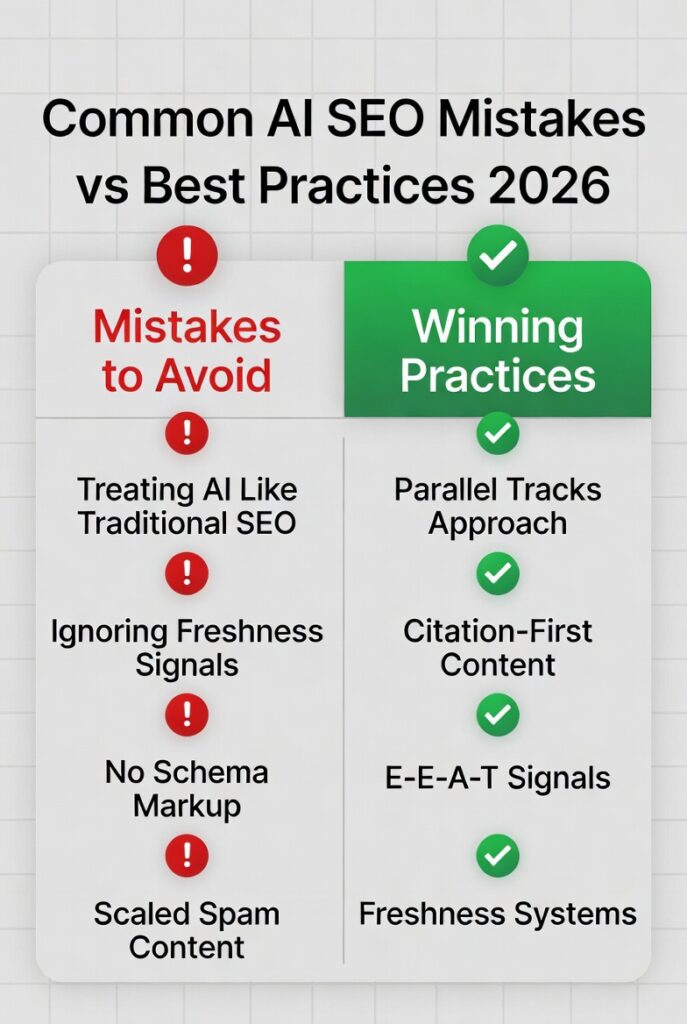
- 5 Mistakes Destroying Results
- Tools — What to Use, Avoid, Trust
- Your 6-Week Action Plan
- FAQ — 13 Questions Answered
Every piece of ChatGPT SEO advice published in the last 18 months has been wrong in the same direction: it treats the tool as a content machine and the platform as a search engine. Neither framing survives contact with real data.
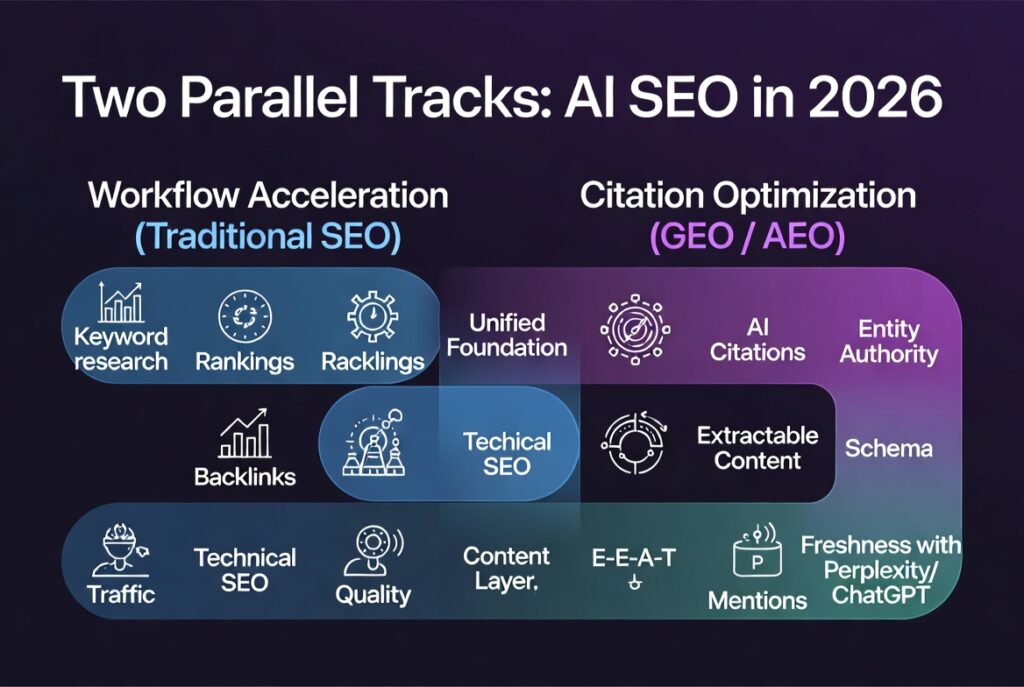
The practitioners generating measurable gains right now have figured out something the mainstream hasn’t caught up to yet: ChatGPT SEO is two separate disciplines that share a technical foundation but require completely different tactics. Collapsing them into a single “AI content strategy” is the most reliable way to waste 90 days and produce nothing.
This framework separates them clearly. You’ll walk away with the implementation sequence, the exact prompts, a tested 6-week action plan, and the mistakes that are quietly destroying results for most teams — including some that directly contradict popular advice.
What Does “ChatGPT SEO” Actually Mean in 2026?
The term has two completely different meanings that are constantly confused. Used precisely, “ChatGPT SEO” describes: (1) using ChatGPT as a tool to accelerate and sharpen SEO workflows — clustering, briefing, drafting, auditing; and (2) structuring your content so AI platforms like ChatGPT select it as a citation source in conversational responses.
These two practices share a technical foundation. But they require different success metrics, different tactics, and different timelines. A practitioner using GPT-4 to speed up their content pipeline is doing Track A. A practitioner implementing FAQ schema to appear in AI responses is doing Track B. Neither is wrong. But treating them as interchangeable produces results that satisfy neither goal — which is exactly why most “ChatGPT SEO” initiatives produce nothing measurable after 90 days.
- Keyword clustering at scale
- Content brief generation
- First-draft acceleration
- Content gap auditing
- SERP intent mapping
- Refresh identification
- Schema markup implementation
- Direct-answer content structure
- AI bot crawl access audit
- Topical cluster architecture
- Share of Model tracking
- Content freshness cycles
The central argument of this entire framework: ChatGPT SEO only produces durable results when workflow automation (Track A) and citation optimisation (Track B) are treated as distinct disciplines with distinct metrics — not collapsed into a single “AI content strategy.” Hold this distinction as you read everything that follows.
How ChatGPT SEO Actually Works: The 3-Phase Implementation Framework
The practitioners consistently outperforming their peers aren’t doing more — they’re doing things in the right sequence. The 3-phase structure below reflects what’s working in practice as of Q2 2026. The order is non-negotiable: Phase 1 failures contaminate everything downstream, and most teams skip it entirely because it looks like infrastructure rather than strategy.
Why Phase 1 Failures Contaminate Everything Else
Before ChatGPT enters your workflow at any level, your site needs to meet the baseline technical and trust requirements that AI systems use when deciding what to cite. This is not a content strategy question. It is an infrastructure question — and the data makes the stakes unambiguous.
Phase 1 has three non-negotiable components. None can be delegated to ChatGPT. All three must be completed before a single piece of content is published or a single workflow is automated.
- 1AI bot access audit — the single highest-leverage action in this entire framework Open your
robots.txtfile. Confirm GPTBot (ChatGPT’s crawler), Anthropic’s ClaudeBot, and PerplexityBot are explicitly allowed. Many sites have legacy rules from 2022–2023 technical audits that block crawlers indiscriminately. If your rules includeUser-agent: *with broad Disallow paths, verify you haven’t inadvertently blocked AI bots. This takes 10 minutes and is the highest-leverage single action in this guide — because no structural content optimisation produces citation results if the AI platform cannot crawl your pages. - 2Schema implementation priority stack Start with FAQ schema on your 10 highest-traffic informational pages. Add HowTo schema to any numbered-process articles. Add Article schema with explicit author credentials, publication dates, and modification dates to your 20 most authoritative pieces. Validate every implementation at schema.org’s structured data validator before pushing to production. Do not trust plugins to validate automatically — check each page manually.
- 3Topical authority signal audit AI systems weigh topical consistency across your domain when selecting citation sources. A site with 40 articles spread across 12 disconnected topics sends weaker authority signals than a site with 40 articles tightly clustered around 3–4 core topic areas. Audit your existing content architecture against your 5 most important query clusters. Identify where you have real depth and where you have isolated pieces with no supporting cluster structure. This audit shapes every editorial decision in Phase 2.
robots.txt via a legacy wildcard rule from a 2023 crawl budget optimisation pass. The team had never revisited it. Removing the block and implementing FAQ + Article schema across their top 20 pages produced measurable citation appearances within six weeks. The content itself required zero changes. The 4-Stage ChatGPT Content Workflow
The content operations teams producing 8+ high-quality pieces per week aren’t prompting ChatGPT to “write articles.” They’ve built systems — with defined human oversight gates at each stage. Below is what those systems look like in practice. The gates are not optional.
- 1Keyword clustering — from 3–4 hours to 25 minutes Feed a seed keyword list into ChatGPT. Prompt it to group keywords by search intent (informational, navigational, commercial, transactional) and flag which clusters compete for the same SERP positions. The output is a clustering map, not final decisions — a human reviews and adjusts for brand priorities and competitive gaps before a single brief is written. Using systematic keyword research as input significantly improves the clustering quality.“You are a senior SEO strategist. Group the following [X] keywords into intent-based clusters. For each cluster: (1) name the primary intent, (2) identify a pillar keyword, (3) flag any clusters competing for the same SERP positions, and (4) note the likely content format that ranks for this intent. Keywords: [paste list]“
- 2Brief generation — from 1.5 hours to 20 minutes Build a content brief template once. Then run this prompt against each approved cluster. Human review is mandatory before writing begins — the brief is the strategic document, not the first draft.“Act as a senior SEO editor. Based on keyword cluster [X] and the following SERP summary [paste top 3 result titles/descriptions], generate a detailed content brief identifying: (1) primary entity relationships, (2) subtopics required to match search intent, (3) the specific questions users are trying to answer, (4) content gaps vs. top 3 results, and (5) the ideal H2 structure. Flag any claims that will require primary sources.”
- 3First-draft acceleration — with a mandatory human layer Against the approved brief, use ChatGPT for a structured first pass. The first draft is never published. It is edited for factual accuracy, differentiated with original insight and real examples, and rewritten at the paragraph level wherever the AI defaulted to generic phrasing. The teams getting penalised are the ones skipping this editorial gate. AI-generated content that reaches publication without differentiation is now directly triggering Google’s scaled content abuse filters — with both ranking and citation penalties.
- 4Content refresh pipeline — the highest-ROI application, consistently underused The ROI asymmetry here is enormous. Content refreshed in the past 90 days averages 6 AI citations vs 3.6 for older pages. Paste existing articles into ChatGPT with the audit prompt below. Use the output as a rewrite brief — not as replacement content.“You are a senior SEO editor. Review this article for: (1) outdated statistics — flag anything that could have changed since publication, (2) missing subtopics relative to the keyword ‘[target keyword]‘, (3) sections that don’t directly answer the implied question in the first two sentences, and (4) information a competitor’s updated article might now cover better. Return a prioritised list of changes, not a rewritten article. Article: [paste content]“
How AI Systems Actually Decide What to Cite
AI systems select sources based on trust signals that diverge from traditional Google ranking factors — sometimes dramatically. Ahrefs’ October 2025 research found 28.3% of ChatGPT’s most cited pages have zero organic Google visibility. Your Google rank does not automatically transfer to AI citation authority. These are different surfaces with different selection criteria.
A June 2025 Profound study tracking over 30 million AI citations found ChatGPT pulls 47.9% of its citations from Wikipedia. That data point is the clearest signal available about what the model actually rewards: structured, canonical, definitional explanations with clear factual grounding. Not brand blogs. Not SEO-optimised landing pages. Sources that answer questions the way a reference document does.
Writing content that reads like a reliable reference document — not a brand blog — is the closest practical summary of what ChatGPT rewards as a citation source. Structure, specificity, and freshness outweigh domain authority and organic ranking signals.
— Synthesised from Profound (30M+ citation analysis), Ahrefs, and AirOps research, 2025–2026Schema Implementation Priority Matrix
Citation Optimisation Signal Reference
| Optimisation Signal | Measured Citation Impact | Implementation Effort | Timeline to Effect |
|---|---|---|---|
| FAQ schema | +28% coverage | Low (1–2 hrs) | ~21 days |
| 3+ schema types per page | +13% citation likelihood | Medium (3–5 hrs) | 3–6 weeks |
| 3+ comparison tables per article | +25.7% citations | Medium (content rework) | 4–8 weeks |
| ≤10 words avg. sentence length | +18.8% citations | Low (editing pass) | 4–8 weeks |
| Direct-answer lead paragraph | High (qualitative) | Low (60-word rewrite) | 4–6 weeks |
| GPTBot allowed in robots.txt | Required for any citation | Very low (10 min) | Immediate |
| Content refreshed <90 days old | 6 vs 3.6 avg citations | Medium (refresh cycle) | Ongoing |
| Topical cluster (vs isolated articles) | Compound authority effect | High (strategic) | 3–6 months |
| Keyword stuffing / over-optimisation | Negative signal confirmed | N/A — avoid entirely | N/A |
| Unedited AI-generated content | Scaled content abuse risk | N/A — editorial layer required | N/A |
How to Measure ChatGPT SEO Results When There’s No Console
Most ChatGPT SEO strategies plateau at month 3. The cause is almost always the same: teams treat citation optimisation as a one-time content project rather than an ongoing measurement discipline. There is no ChatGPT Search Console. You cannot pull a citation report the way you pull a rank report.
What you can measure is Share of Model — systematically prompting ChatGPT, Perplexity, and Claude with your 10–15 most important buying-intent queries and logging citation frequency weekly. Look for correlations between growing Share of Model and unexplained spikes in direct traffic. Erlin’s 2026 research confirms much AI referral traffic appears as “direct” in Google Analytics — AI-referred visitors frequently don’t carry tracked referral parameters.
Run Share of Model tracking consistently for at least 60 days before drawing conclusions. One week of data is noise. Eight weeks of data is a trend. The teams that build durable AI citation authority treat this as a standing weekly process — not a one-time audit.
What Changed in the Last 12 Months for ChatGPT SEO
Two structural shifts between May 2025 and May 2026 that directly affect practitioner tactics — and that most guides published before mid-2025 haven’t integrated correctly.
Shift 1: The AI Citation Landscape Has Fragmented Across Platforms
ChatGPT is no longer the only AI platform that matters for citation strategy. Google’s AI Mode and AI Overviews now handle a material share of queries — and they cite sources differently from ChatGPT. The platform-specific citation preferences have diverged significantly.
| AI Platform | Top Citation Source | Wikipedia Share | Reddit Share | Strategic Implication |
|---|---|---|---|---|
| ChatGPT | Wikipedia (47.9%) | 47.9% | 11.3% | Rewards structured, canonical, reference-style content above all |
| Google AI Overviews | Reddit (21%) | 5.7% | 21% | Weights community experience and practical, first-person answers |
| Perplexity | Reddit (46.7%) | Low | 46.7% | Strongest community-experience and recency tilt of the three |
| Gemini | Google-indexed authority sites | Moderate | Moderate | Closest to Google AI Overviews pattern; market share ~4x since Jan 2025 |
A single content format does not optimise for all four platforms. Brands focused exclusively on Wikipedia-style canonical content for ChatGPT may be largely invisible in Google AI Overviews. A complete GEO content strategy in 2026 needs to produce both authoritative reference content and community-experience-forward content — which may require different formats, different distribution channels, and different measurement frameworks for each platform.
Shift 2: Traditional Organic Traffic Is Declining Faster Than AI Traffic Replaces It
This is the most important macro context for any ChatGPT SEO strategy in 2026. Google search referrals to publishers dropped approximately a third in the year to November 2025 (Chartbeat data). AI referral traffic, while growing at 206% year-over-year, still represents approximately 0.15% of global internet traffic — versus 48.5% from organic search.
Proven ChatGPT SEO Strategies With the Strongest 2026 Evidence
The Most Underused Strategy: Content Refresh Over Net-New Production
Most teams allocate the majority of their content budget to net-new pieces. The data in 2026 argues strongly for the opposite allocation. Content refreshed in the past three months averages 6 AI citations versus 3.6 for older pages — a 67% citation lift at a fraction of the cost of new production.
The mechanism is a pronounced recency bias in AI citation engines. They weight freshness as a proxy for accuracy. A 2021 statistic in a prominent position — even in an otherwise authoritative article — signals potential staleness to the retrieval system. Refreshing your top 20 organic articles to replace outdated data, rewrite the opening 60 words in direct-answer format, and add FAQ schema produces higher citation frequency per hour invested than any equivalent volume of new content.
The Approach That Contradicts Popular Advice: Schema Before Content Volume
The dominant advice is to produce more content, more thoroughly, targeting more questions. The 2026 evidence suggests structured data implementation produces faster and more predictable citation gains than volume increases — especially when implemented on strong existing content that was previously inaccessible to AI crawlers or lacking structured signals.
FAQ schema increases AI coverage by approximately 28% in 21 days. That is a faster, more measurable return than any production schedule. Ahrefs’ citation research consistently supports this: the structural quality of existing content outweighs the quantity of new content in determining AI citation frequency. The teams that implement schema across existing content first — then build new content on a schema-ready foundation — consistently outperform teams that prioritise volume.
The Strategy Most Practitioners Skip: Distributed Authority
AI citation engines triangulate authority. A single well-structured article is a weaker citation signal than that article supported by a podcast appearance, a guest post on a credible domain, a LinkedIn thread, and a Reddit comment — all covering the same core claim in your own words from different angles.
Your post plus a podcast appearance plus a guest spot plus three LinkedIn posts plus a YouTube video plus a Reddit thread will get cited. The engines triangulate. They want to see you said the same thing, in your own words, in five different places online. Then they trust you.
— Lilach Bullock, AI SEO Research 2026 (lilachbullock.com)Consistent topical presence on LinkedIn in 2026 carries more citation value than it did in 2020 — not because LinkedIn ranks in Google, but because LinkedIn corroborates. AI systems looking for triangulating signals find the same expert making the same claim in multiple contexts. That convergence drives authority. Building distributed authority signals is one of the most underinvested areas in most SEO strategies.
The 5 ChatGPT SEO Mistakes That Are Quietly Destroying Results
These are not theoretical failure modes. They are consistent patterns across teams that report “trying ChatGPT SEO” without measurable gain. Each has a specific root cause — not just a symptom.
| Mistake | Root Cause | Self-Audit Question |
|---|---|---|
| Optimising for volume when signal quality drives results | Mental model inherited from 2015–2022 content era | “Could Google’s scaled content abuse filter flag any of my last 10 published pieces?” |
| Treating AI citation and Google ranking as the same objective | Collapsing two different disciplines into one strategy | “Am I measuring citation frequency separately from rank tracking?” |
| Publishing AI-generated content without editorial differentiation | Confusing draft acceleration with production completion | “Does every published piece contain something ChatGPT could not have generated — a real example, original data point, or named counterargument?” |
| Ignoring bot access settings | Legacy technical debt never revisited | “Has GPTBot been explicitly allowed in my robots.txt within the last 6 months?” |
| No topical cluster architecture | Isolated article thinking from standalone-post era | “Does this article link to and from at least 3 related pieces covering the same core topic?” |
Mistake 1: Volume Over Signal Quality
From 2015 to 2022, content volume was a legitimate lever — publishing three pieces per week consistently produced compounding traffic gains because Google’s systems rewarded topical breadth. That model still partially holds for traditional organic search. It breaks entirely for AI citation.
AI systems don’t cite sources for topical breadth. They cite sources for perceived authority and factual reliability on a specific question. A single 2,000-word piece that definitively answers one question — with named sources, structured data, updated statistics, and a direct-answer lead — will outperform ten broader pieces every time in citation frequency. Semrush’s 2026 content research confirms this pattern across multiple verticals.
Mistake 2: Tracking the Wrong Metrics
This mistake is invisible because it feels like progress. Teams run ChatGPT-assisted workflows, publish regularly, and watch their content volume grow. What they’re not watching: whether ChatGPT, Perplexity, or Google’s AI Overviews are actually citing them for target queries.
The cognitive bias at work is effort justification — we measure what we can see (published word count, articles live, organic sessions) and ignore what requires more effort to measure (AI citation frequency, Share of Model, branded queries appearing in AI responses). Ahrefs’ data is unambiguous: there is a weak correlation between high organic Google traffic and ChatGPT citation. High ranking does not guarantee AI citation — and that gap is where most teams’ results disappear.
ChatGPT SEO Tools: What to Use, Trust, and Avoid
| Tool | Category | Best Used For | Key Limitation | 2026 Verdict |
|---|---|---|---|---|
| Ahrefs | Research / Technical | Content gap analysis; identifying pages with organic visibility but low AI citation | AI citation data still in early development | Core tool |
| Semrush | Research / Tracking | AI traffic trend benchmarking; keyword clustering input data | No robust AI citation tracking yet | Core tool |
| SE Ranking | Monitoring | AI Overviews visibility tracking; content freshness monitoring | Primarily Google-focused | Useful |
| ChatGPT / Claude / Perplexity (manual prompting) | Citation tracking | Share of Model baseline and weekly tracking across 15 core queries | Labour-intensive; not scalable beyond ~15 queries | Essential baseline |
| Schema.org Validator | Technical | Validating all structured data before deployment — non-negotiable step | Validation only, no recommendations | Required step |
| Google Search Console | Performance | Monitoring organic CTR decline on AI Overview-impacted queries; tracking direct traffic anomalies | No AI citation data | Core tool |
| Most “AI SEO score” tools | Automation | — | Scoring methodology often opaque; criteria not validated against actual citation data | Avoid until validated |
Research Sources Worth Following
Ahrefs Blog produces original citation frequency studies with proprietary crawl data. Their work on the weak correlation between Google rank and ChatGPT citation is the most consistently cited and methodologically rigorous in the space. Position Digital’s AI SEO Statistics is the most comprehensive aggregator of AI search data, updated regularly, and explicitly distinguishes between AI Overviews, ChatGPT, and Perplexity citation patterns. Erlin.ai research provides client-side data on content refresh cycles and citation frequency that fills a gap between theoretical research and practitioner implementation. SEO Sherpa’s platform comparison analysis is the clearest breakdown of platform-specific citation behaviour currently available.
Caveat on dated agency content: Many agency posts on “ChatGPT SEO” published before mid-2024 predate both the GPTBot crawl access issue being widely understood and the citation frequency research that has since changed tactical priorities. Verify publication dates before acting on specific recommendations — this space moves quickly enough that 18-month-old advice is often structurally wrong, not just incomplete.
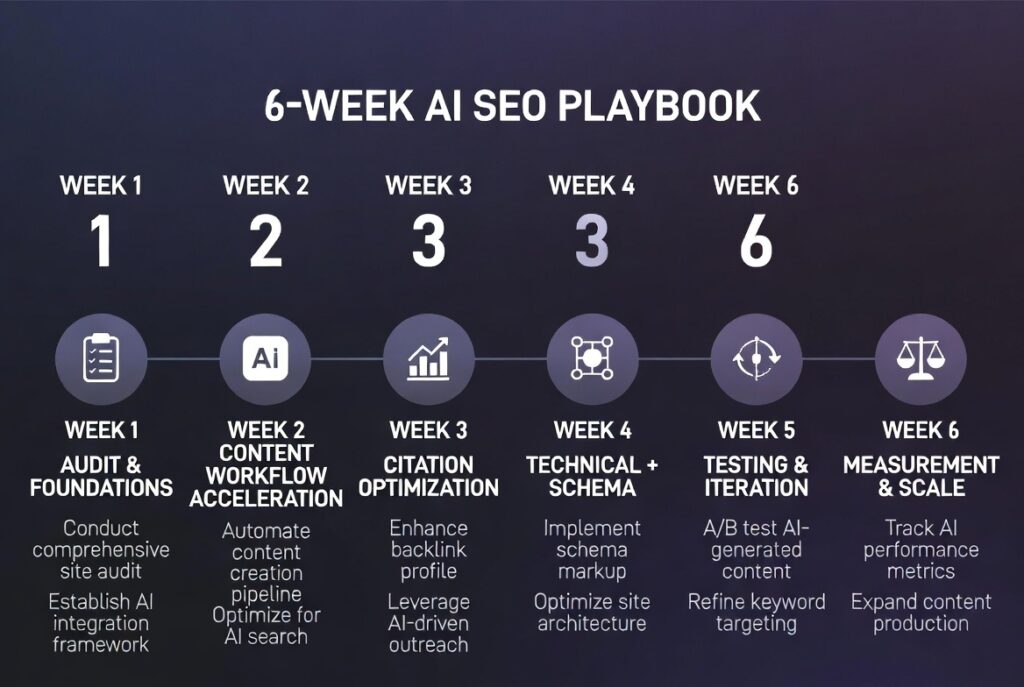
Your 6-Week ChatGPT SEO Action Plan
This plan prioritises the highest-ROI actions in the correct sequence. Do not skip to week 3 without completing weeks 1–2. The technical foundation is not optional infrastructure — it is the mechanism through which all subsequent content work produces results. Ninety percent of teams that report “ChatGPT SEO doesn’t work” skipped weeks 1 and 2.
- Day 1 (90 min): Open
robots.txt. Confirm GPTBot, ClaudeBot, and PerplexityBot are explicitly allowed. Fix any legacy wildcard blocks immediately. - Day 2 (2 hrs): Run your top 20 pages through Google’s Rich Results Test. Flag every page with zero schema. Create a prioritised implementation list.
- Days 3–5 (3–4 hrs): Implement FAQ schema on your 10 highest-traffic informational pages. Add Article schema with author credentials and dates to your 20 most authoritative pieces. Validate every implementation with the schema.org validator before publishing.
- Days 6–7 (2 hrs): Pull GA4 direct traffic trend for the past 6 months. Record this as your pre-optimisation baseline — you’ll compare against it at week 5.
- Days 8–10 (3 hrs): Run your 15 most important buying-intent queries in ChatGPT, Perplexity, and Claude. Log: which brands appear, which specific pages are cited, what structural elements those pages share. This Share of Model baseline is the most important strategic document you will build in this entire process.
- Days 11–14: Take your 5 most-cited organic articles. Run the ChatGPT audit prompt (from Phase 2, Track A). Use output as a rewrite brief — not as replacement content.
- Days 15–17: Rewrite the opening 60 words of each audited article in direct-answer format: one sentence that answers the implied question, then the reasoning. This is the single structural change most correlated with AI citation in Erlin’s research.
- Days 18–20: Update all statistics from 2023 or earlier to 2025–2026 sources. Any stale data point is a citation risk — AI systems detect recency discrepancies. Add a comparison table to any article covering evaluative or “best of” content.
- Days 21–25: Map existing content against your Share of Model baseline. For each query cluster where competitors appear but you don’t, identify: (a) no content exists, (b) content exists but lacks schema, or (c) content exists but lacks direct-answer structure. Separate these three root causes — they require different solutions.
- Days 26–28: Build your 90-day editorial plan at a 70/30 ratio — 70% refresh, 30% net-new. Net-new pieces should only target confirmed gaps from your Share of Model audit.
- Days 29–32: Re-run your 15 Share of Model queries. Compare to the baseline from weeks 1–2. Look for: new citations appearing, competitor citations disappearing, new query patterns emerging. Any movement this early is a strong positive signal.
- Days 33–35: Check GA4 direct traffic against baseline. Unexplained upward movement without a corresponding increase in paid or referral channels is likely AI referral traffic without UTM attribution — this is your early validation signal.
- Days 36–40: Build your ChatGPT workflow system: keyword clustering template, content brief template, and audit prompt — documented, standardised, ready to hand to any team member. The system, not the individual prompts, is what scales.
- Days 41–42: Implement HowTo schema on any numbered-process articles not yet marked up. Aim for full schema coverage across your top 40 pages by end of week 6.
1. Allow GPTBot in robots.txt (10 min, unlocks all subsequent work)
2. Implement FAQ schema on 10 highest-traffic pages (2 hrs, +28% citation coverage)
3. Build your Share of Model baseline across 15 core queries (3 hrs, the strategic foundation)
Start Here — Right Now
Take your 3 most important buying-intent keywords. Run them in ChatGPT, Perplexity, and Claude. Write down which brands appear, which specific pages are cited, and what structural elements those pages share — direct-answer leads, comparison tables, schema markup, recent publication dates. That 20-minute exercise will show you your actual competitive gap more clearly than six months of reading about ChatGPT SEO. Then start with the one action that costs nothing and unlocks everything else: confirm GPTBot is allowed in your robots.txt.
Explore More Advanced SEO Frameworks →✅ Post-Publishing Optimisation Checklist
- GPTBot, ClaudeBot, and PerplexityBot explicitly allowed in robots.txt
- FAQPage schema applied to FAQ section — validated via schema.org validator
- HowTo schema applied to any numbered-process sections
- Article schema with author name, datePublished, and dateModified at page level
- Canonical tag set correctly — no duplicate URLs
- LCP under 2.5s (Core Web Vitals) — test via PageSpeed Insights
- Primary keyword “ChatGPT SEO” appears 3–5 times, distributed naturally across H1, H2s, and body copy
- Meta description 150–160 characters, includes primary keyword and a concrete benefit claim
- All internal links use descriptive anchor text pointing to relevant seohack.info pages
- All external links point to named, credible primary sources — open in new tab, rel=”noopener noreferrer”
- H1 appears exactly once; H2s follow logical hierarchy without skipping levels
- Every H2 opens with a direct 40–55 word featured-snippet-eligible answer
- Every statistic has a named source and a publication date — no undated claims
- No AI-pattern phrases present (check: “game-changer”, “dive into”, “seamlessly”, “robust”, “leverage” as verb, “delve”)
- FAQ answers are 60–90 words each, standalone, and non-redundant with main content
- Author box includes methodology note and explicit “Last Updated” date
- Submit URL to Google Search Console for indexing
- Run 15 Share of Model queries as a citation baseline — log in tracking spreadsheet
- Set a 90-day content refresh reminder for this page
- Share in 2–3 topical LinkedIn posts referencing the core claim (distributed authority signal)
- Monitor GA4 direct traffic at 30-day mark — correlate with AI citation appearances
Frequently Asked Questions: ChatGPT SEO in 2026
robots.txt and explicitly allow GPTBot (ChatGPT’s crawler), ClaudeBot, and PerplexityBot. This is the highest-leverage single action in the entire discipline because no structural content optimisation produces citation results if the AI platform cannot crawl your pages. After confirming access, implement FAQ schema on your highest-traffic informational pages: 2026 research shows FAQ schema increases AI citation coverage by approximately 28% within 21 days of deployment. These two steps together — crawler access and FAQ schema — represent the fastest path to measurable citation improvement available in the current landscape.AI Search in 2026: What Actually Wins (Data, Not Manifestos)
The ChatGPT SEO Myth: Why Measurement Failure Kills the Strategy
Wikipedia Lost 435 Visibility Points. Your Authority Buffer Just Shrunk