
Google penalizes low-value, ranking-manipulative content regardless of how it was produced, so enterprise AI SEO governance should be built around editorial accountability, not tool bans. Since Article 50 of the EU AI Act took effect on August 2, 2026, disclosure is also a legal requirement — but text watermarking degrades so fast under ordinary editing that it can’t carry the compliance burden; a documented human review chain has to.
TL;DR
- Google’s spam policy targets scaled content abuse — volume plus intent to manipulate rankings — not AI authorship. Human-written spam gets the same penalty.
- EU AI Act Article 50 has been live since August 2, 2026. It requires machine-readable marking of AI-generated content and disclosure of AI-generated public-interest text, with fines up to €15 million or 3% of global turnover.
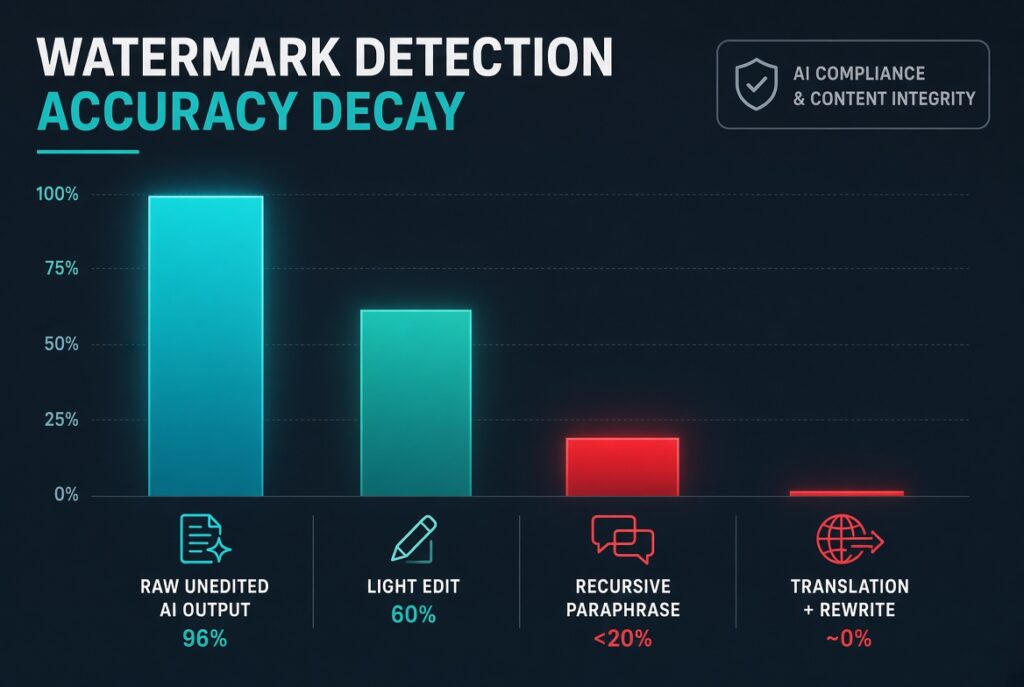
- Text watermarking — including the one Anthropic added to Claude output in August 2026 — is real and deployed, but independent research shows detection accuracy on watermarked text can fall below 20% after a handful of paraphrase passes.
- A policy that leans on “we’ll detect it later” is building its compliance case on infrastructure that doesn’t hold under normal editorial handling. The control that actually survives scrutiny is a named, accountable human editor and a logged review step, completed before publication.
- Below: what Google actually checks, what Article 50 actually requires, why detection can’t be the enforcement mechanism, two decision frameworks you can put into a policy document this quarter, and where the whole approach still has real limits.
The governance question enterprises are answering wrong
Most enterprise AI content policies drafted in 2024 and 2025 tried to answer one question: how do we stop people from publishing obviously AI-written pages? That question is now the wrong one, for two reasons most policy documents still don’t reflect.
First, Google settled the “is AI content allowed” debate years ago and hasn’t moved off that position since. Its Search Central guidance states that appropriate use of AI or automation isn’t against its guidelines, and that the violation is using automation with the primary purpose of manipulating rankings — a standard that applies identically to content written entirely by hand. The enforcement mechanism, scaled content abuse, is defined by volume and manipulative intent, not by production method.
Second — and this is the part almost no internal governance document has caught up with — a separate legal regime now requires something Google never asked for. As of August 2, 2026, Article 50 of the EU AI Act obligates providers of generative AI systems to mark synthetic content in a machine-readable format, and obligates deployers publishing AI-generated text on matters of public interest to disclose that fact, unless the text underwent substantive human editorial review with a named person holding editorial responsibility for it. That exemption clause is the load-bearing sentence in the entire regulation for a content business, and most policies treat it as a footnote.
So the real governance problem heading into 2027 isn’t “should we use AI to draft.” It’s “can we produce, on request, a record of exactly who reviewed this piece, what they checked, and why they’re willing to be named as accountable for it.” That’s a workflow and recordkeeping problem, not a tooling problem — which is precisely where most enterprise policies have built on the wrong layer of the stack.
What Google actually grades — and what it never asks
Google’s documentation is unusually direct here, and it’s worth separating from the SEO-industry commentary that has grown up around it. Three things get checked: whether content was produced at scale primarily to capture rankings (spam policies, Quality Rater Guidelines section 4.6.5), whether it shows little effort or added value regardless of scale (section 4.6.6), and whether it demonstrates the experience, expertise, authoritativeness, and trust signals raters are trained to evaluate.
None of those three checks reference a detection tool, a watermark, or an AI-use disclosure badge. Google has also told site owners that sharing information about how content was produced can help build reader trust, and suggests background information on automation where it makes sense for the audience — but this is framed as an optional trust signal, not a ranking input. The practical implication for a governance policy: banning AI drafting tools outright buys nothing with Google, and neither does a disclosure badge by itself. What buys something is what always did — verified facts, a named author with real standing on the topic, and enough original analysis that cutting a third of the page would make it measurably worse.
| Framework | What it actually regulates | Trigger | Penalty exposure |
|---|---|---|---|
| Google spam policies (scaled content abuse) | Volume + intent to manipulate rankings, any authorship | Pattern of low-value pages at scale | Ranking demotion, index removal — no fixed monetary fine |
| Google helpful content / E-E-A-T | Depth, originality, demonstrated expertise | Content judged unhelpful regardless of scale | Ranking demotion |
| EU AI Act, Article 50(2) | Machine-readable marking of AI-generated synthetic content | Any provider placing a generative AI system on the EU market | Up to €15M or 3% of global turnover |
| EU AI Act, Article 50(4) | Disclosure of AI-generated public-interest text | Deployer publishing without substantive human editorial review | Up to €15M or 3% of global turnover |
These regimes don’t overlap the way most policy drafts assume. An organization can sit fully inside Google’s guidelines while sitting outside Article 50 compliance, and the reverse is equally true — a fully disclosed, watermark-compliant page can still be thin, scaled, and demoted on quality grounds. Treating both as one checklist item (“are we AI-compliant?”) is how enterprises end up passing neither test well.
Article 50, in practice, for a content organization
Article 50 carries four distinct obligations, and only two touch a typical content or SEO team directly. AI systems that interact with people — chatbots, voice assistants, on-site AI agents — must disclose that the user is talking to a machine, unless that’s already obvious from context. Emotion-recognition and biometric-categorization systems carry a separate notice duty that rarely applies to editorial teams. The two that matter for publishers: synthetic-content marking, which falls on the AI system provider, and public-interest text disclosure, which falls on the deployer — meaning the enterprise publishing the piece, not the AI vendor that helped draft it.
The exemption clause is worth building an entire workflow around: disclosure isn’t required for AI-generated public-interest text that underwent substantive human editorial review, with a person or entity assuming editorial responsibility for its publication. The Act doesn’t set a numeric threshold for “substantive,” and the European Commission’s July 2026 guidance and the voluntary Code of Practice — signed by roughly 190 organizations including the major model providers — add interpretive detail without a bright line. What they do make clear is the shape of evidence a regulator would expect: a documented review, a named accountable person, and a timestamp showing the review happened before publication, not as an after-the-fact justification once someone asked questions.
A four-month transitional window applies only to the machine-readable marking obligation for generative systems already on the market, running to December 2, 2026 — it is not a general grace period. The interaction-disclosure and deployer-disclosure duties have applied in full since August 2, 2026. Anyone still treating any part of Article 50 as “coming regulation” is already weeks behind an obligation that’s active today.
Why the watermark can’t be your compliance strategy
This is the single most consequential thing to understand before writing a governance document: the technical mechanism Article 50 leans on for text — machine-readable marking, in practice a statistical watermark — is real and deployed, but too fragile to serve as the backbone of a compliance program.
Google has run SynthID-Text in Gemini’s consumer products since 2024. Anthropic disclosed in August 2026 that Claude models released after Article 50 took effect embed a comparable token-level watermark by default, with no option to disable it, alongside a public detection interface. The mechanism nudges each generated word toward a secret-key-selected subset of otherwise acceptable choices — nothing visible changes in the text, but a statistical signal survives that a detector can check for later.
The problem is what “survives” means in practice. Independent research on these techniques found that five rounds of recursive paraphrasing dropped detection accuracy on watermarked text below 20%, and one widely cited detector’s discrimination score fell from 96.5% to 59.8% under the same attack. That isn’t a defect better engineering quietly fixes — the underlying research ties the ceiling on any detector’s performance to how statistically similar AI and human text distributions are, and that similarity keeps narrowing as models improve. A watermark also only tells you that unedited model output passed through the system at some point; it says nothing about who wrote it, whether it’s accurate, or whether a human reviewed it before publication. A piece that gets even a light editorial pass, a translation, or a rewrite tool can lose the mark entirely — which means the content most likely to still carry a detectable watermark is exactly the content that received the least human handling. That’s backward from what a governance program should want to reward.
The practical conclusion: build the Article 50 evidence trail — and the Google E-E-A-T case — around the human review step itself, not around a detector’s output. A watermark can inform a disclosure decision. It cannot replace the record of who reviewed the piece and what they checked.
Detection decay: the curve governance should design around
The failure mode above is easier to see as a curve than a sentence. Detection performance on AI-generated text doesn’t fail gracefully — it collapses once ordinary editorial handling is applied, well before the text reaches anything resembling deliberate evasion.
Read it the other way: that curve is useful rather than discouraging. It means the content most likely to still carry a detectable watermark is exactly the content that skipped meaningful human review — pasted straight from the model with no edit pass. A watermark, in other words, is a rough proxy for “this probably wasn’t reviewed,” which is genuinely useful for internal audit, even though it’s useless for proving compliance on content that was properly handled. Point monitoring at the failure case the technology can actually catch, and stop asking it to prove the positive case it structurally can’t.
The Three-Gate Disclosure Test
This is an original planning heuristic for triaging Article 50 exposure — a working tool for editors and legal reviewers, not a restatement of the regulation and not a substitute for legal advice on a specific piece.
Most editors don’t need to re-derive Article 50 from the text of the regulation for every article. They need a fast, repeatable sequence that escalates only when it should.
- Scope gate — Does this content reach an EU audience, or does the organization operate in the EU market? If no, Article 50 doesn’t directly apply, though Google’s quality standards still do everywhere. If yes, continue.
- Subject-matter gate — Is the content AI-generated or AI-manipulated text on a matter of public interest (news-adjacent analysis, civic or political topics, health or safety guidance)? Routine product content, internal documentation, and most commercial marketing copy typically sit outside this gate. If the content clears this gate, continue.
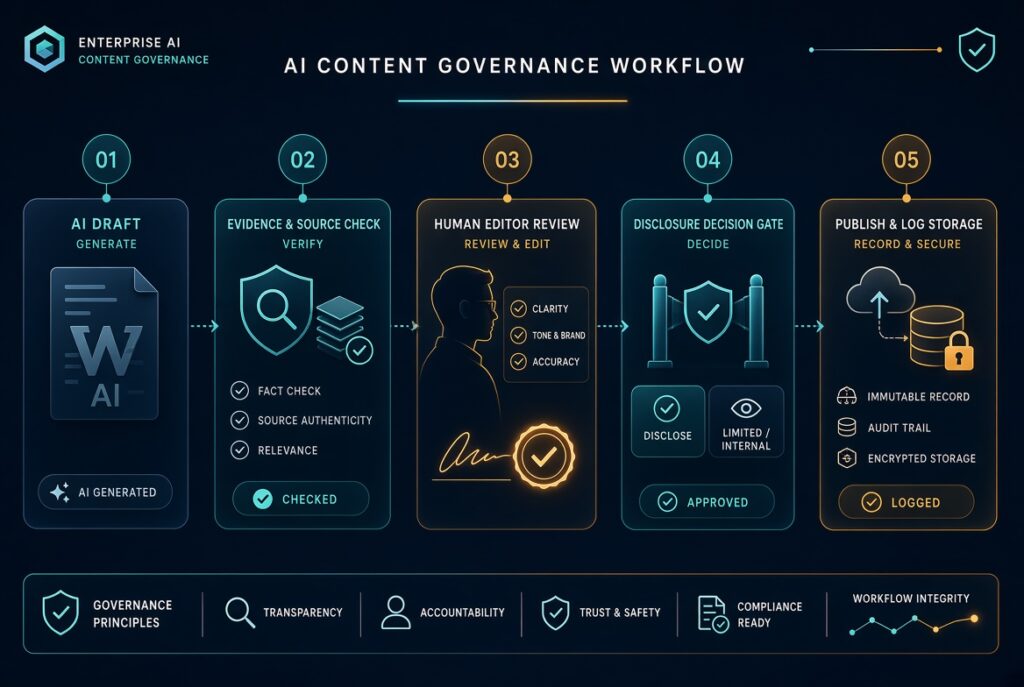
- Review-sufficiency gate — Did a named individual conduct and document a substantive editorial review before publication, and are they willing to be recorded as holding editorial responsibility for the piece? If yes, the disclosure obligation is very likely satisfied through the exemption, and the record of that review is the evidence that matters. If no — or if that review can’t be documented — disclose.
The output of Gate 3 is what actually needs to live in your content management system: a timestamp, a name, and a short note on what was checked. That record is worth more than any badge or detection score, because it’s the artifact both Article 50 and a Google search-quality rater are, in different ways, looking for.
Building the framework: risk tiers, not blanket rules
A workable policy doesn’t treat “AI-assisted” as one category. It sorts content by what happens if it’s wrong, then applies review depth accordingly — the same logic NIST’s AI Risk Management Framework applies at the system level, mapped down to the article level.
| Risk tier | Example content | Minimum control | Who signs off |
|---|---|---|---|
| Low | Product update summaries, internal glossary entries, evergreen how-to refreshes | Single editorial pass; spot-check against source | Content lead |
| Medium | Comparison articles, statistics-heavy explainers, competitor analysis | Fact-check pass against primary sources; named byline; citation audit | Senior editor + subject reviewer |
| High | Financial, medical, legal, or regulatory-adjacent guidance; anything citing named studies or figures | Full evidence trail; domain-expert review; legal/compliance check; disclosure decision logged | Editor-in-chief or compliance officer, named and recorded |
| Public-interest text (Article 50 scope) | News-adjacent analysis, policy commentary, political or civic topics | All of the above, plus an explicit editorial-responsibility record for the Article 50 exemption | Named individual assuming legal editorial responsibility |
The structure that enforces this needs a small cross-functional group rather than a single owner: a governance lead who runs day-to-day review and keeps the content inventory, a legal or compliance reviewer who maps obligations like Article 50 as they evolve, and a business or editorial lead who owns the quality bar. Committees that exist only as a filed policy document, with no recurring review cadence, consistently miss the drift that accumulates as models, regulations, and detection capability all shift under the policy at once.
There’s a broader lesson here worth stating plainly, because it explains why so many of these programs stall before they produce anything. MIT’s NANDA initiative published The GenAI Divide: State of AI in Business 2025 in July 2025, based on 150 leadership interviews, a survey of 350 employees, and an analysis of 300 public AI deployments. It found that 95% of generative AI pilots failed to deliver measurable profit-and-loss impact, with only about 5% reaching the kind of scaled deployment that produced real returns — and identified weak organizational integration, not model quality, as the primary driver. Content governance isn’t friction on an AI content program. Without it, the program is what quietly erodes.
What the policy document itself should contain
- Scope and tool inventory. Which AI tools are approved for drafting, research, and editing, and which are explicitly out of scope for regulated content categories.
- Risk tiers and review depth, matched to the table above — not one blanket review step for every piece regardless of stakes.
- The disclosure test, written as an operational checklist an editor can apply without escalating every article to legal.
- Named accountability, recorded at publication time for every piece, not reconstructed after a complaint.
- Source and citation discipline: primary sources ranked above aggregators for any factual claim, with an explicit rule against presenting vendor marketing language as independent fact.
- A refresh trigger: which claims are time-sensitive — regulatory deadlines, pricing, statistics, legal status — and how often they’re re-verified. This is where most AI-assisted content quietly goes stale, because AI drafting makes first publication fast and gives no signal that anything needs revisiting later.
The AI Content Governance Maturity Score
A second planning heuristic — a self-assessment an editorial or legal team can run in about twenty minutes, not a certified audit standard and not a predictor of regulatory outcomes.
Score each dimension 0–4 (0 = doesn’t exist, 4 = documented, consistently enforced, and reviewed on a set cadence), then sum.
| Dimension | What “4” looks like |
|---|---|
| Named accountability | Every published piece has a recorded, individually named reviewer of record |
| Documented review | Review notes (not just a sign-off click) are stored and retrievable per article |
| Risk tiering | Content is classified by stakes before drafting begins, not after a complaint |
| Refresh triggers | Time-sensitive claims are flagged at publication with a scheduled recheck date |
| Regulatory mapping | Someone owns tracking Article 50 and equivalent obligations as they change, on a fixed cadence |
0–5: Ungoverned. No defensible record exists if either a regulator or a search-quality rater asks. 6–11: Reactive. Controls exist but only surface after something goes wrong. 12–16: Structured. The framework in this article is substantially in place. 17–20: Defensible. The organization can produce evidence for any published piece on short notice — the bar both Article 50 and Google’s E-E-A-T expectations are, from different directions, pointing toward.
Who should slow down, and who can move fast
Not every content operation needs the full High-tier machinery on every piece, and a policy that applies it uniformly will just get bypassed under deadline pressure. Teams publishing high-volume, low-stakes commercial content — product listings, routine feature updates, internal knowledge-base articles — can run a lighter Low-tier process and reserve deep review for the exceptions a keyword or topic flag catches. Teams publishing anything touching health, finance, law, elections, or named individuals should default to High tier even when a piece looks routine on its face, because the cost of being wrong is asymmetric to the cost of an extra review pass. The organizations most exposed right now are the ones running EU-facing news, policy, or civic content through an AI drafting pipeline with no named reviewer of record at all — that’s the exact fact pattern Article 50(4) was written for, and it’s also the fact pattern most likely to fail a Google E-E-A-T check on the same piece for the same underlying reason: nobody demonstrably stood behind it.
Where this breaks down in practice
None of this is airtight, and a governance document implying otherwise will fail its own credibility test on day one. A named editor’s sign-off is only as good as the time they were actually given to review the piece — a compliance officer asked to clear forty articles a day is a rubber stamp with a job title, not a control. Enterprises operating outside the EU can reasonably ask whether Article 50 applies to them at all; it does if the content reaches EU users or the organization operates in the EU market, which captures most content businesses with meaningful international reach, but a purely domestic publisher with no EU audience sits outside its direct scope — though Google’s quality standards still apply regardless of geography.
The framework also leaves a genuine tension unresolved: the Code of Practice’s marking obligations sit primarily with AI vendors, not publishers, so an enterprise’s compliance posture depends partly on tooling choices made by companies it doesn’t control. A content team using a model from a Code of Practice signatory inherits a marking mechanism; a team using a smaller or non-signatory provider may not get one at all, and the deployer-side disclosure obligation doesn’t disappear just because the upstream tool didn’t cooperate.
The bottom line
The governance question worth answering right now isn’t whether AI is allowed to write. Google decided that years ago, and nothing in its 2026 guidance reopens it. The question is whether the organization can produce, on request, a record of who reviewed a specific piece of AI-assisted content, what they checked, and why they’re willing to put their name on it — because that record is simultaneously the strongest E-E-A-T evidence available and the only reliable path through Article 50’s editorial-responsibility exemption. Detection tooling, watermarks included, is worth deploying as a monitoring signal. It is not, and structurally cannot be, the thing that carries the compliance or quality case on its own. Build the review chain first. Everything else — schema, disclosure badges, tool selection — is downstream of that decision.
The next step for most teams reading this isn’t buying a new tool. It’s running the maturity score above against last quarter’s published output and seeing how many pieces would survive a request for their reviewer’s name.
Sources
- Google Search Central — Guidance on generative AI content
- Google Search Central Blog — Guidance about AI-generated content
- Cooley — EU AI Act Article 50 transparency obligations, effective August 2, 2026
- Paul, Weiss — EU finalises transparency rules for AI-generated content
- arXiv — Watermarks Without Verification: AI Text Watermarking After the EU AI Act
- Liminal — Enterprise AI Governance: Complete Implementation Guide (2026)
- Fortune / CFO Daily — MIT report: 95% of generative AI pilots at companies are failing