


E-E-A-T Hacks for AI-Generated Content: What Actually Works in 2026
Most AI content fails E-E-A-T not because it lacks information — it fails because it lacks signal. Here’s the architecture that fixes it.
Google’s quality systems don’t read your content the way a human does. They scan for evidence patterns — signals that indicate real experience, institutional authority, and a verifiable human behind the work. A 3,000-word article with zero of those signals starts at a disadvantage, no matter how well-written it is.
The central argument: E-E-A-T compliance for AI-generated content is primarily an architecture problem, not an editorial one. Fix the architecture, and quality signals follow — not the other way around.
This guide is for practitioners who have already tried the basics and watched rankings stagnate. What follows is what the evidence supports. Not a formula. Not a guarantee.
What’s inside
What E-E-A-T for AI-Generated Content Actually Means (And Why Most Definitions Miss the Point)
E-E-A-T optimization for AI-generated content means engineering verifiable trust signals — authorship, source attribution, first-person experience markers, and demonstrated domain authority — directly into content architecture, so Google’s quality systems can classify the content as produced by, or reviewed by, a genuine subject-matter expert.
The Working Definition Practitioners Actually Use
E-E-A-T (Experience, Expertise, Authoritativeness, Trustworthiness) is Google’s framework for evaluating content quality, codified in its Search Quality Evaluator Guidelines. But the practitioner version is tighter: E-E-A-T is the auditable evidence that a real person with real qualifications produced or directly supervised the content.
The “Experience” dimension — added when Google updated the acronym from E-A-T in December 2022 — is the one most AI content workflows completely ignore. It refers specifically to first-hand experience: a product reviewer who actually used the product, a financial analyst who personally managed the portfolio being discussed. AI cannot provide this. Humans layered into the workflow can.
Why the Textbook Version Creates Confusion
The textbook version tells practitioners to “demonstrate expertise.” That instruction produces keyword-heavy credential-dropping — author bios stuffed with certifications, citation lists that link to sources without genuine synthesis. Google’s quality raters are trained to distinguish this from authentic expertise.
The confusion: teams treat E-E-A-T as a content checklist rather than a credibility architecture. High-E-E-A-T content earns trust because signals are consistent across the page, the author profile, the domain’s link profile, and the topical coverage pattern. Checking boxes in a single article while neglecting the surrounding infrastructure produces documents that pass surface review but fail deeper quality assessment. Every time.
How E-E-A-T Optimization for AI-Generated Content Actually Works: The Real Framework
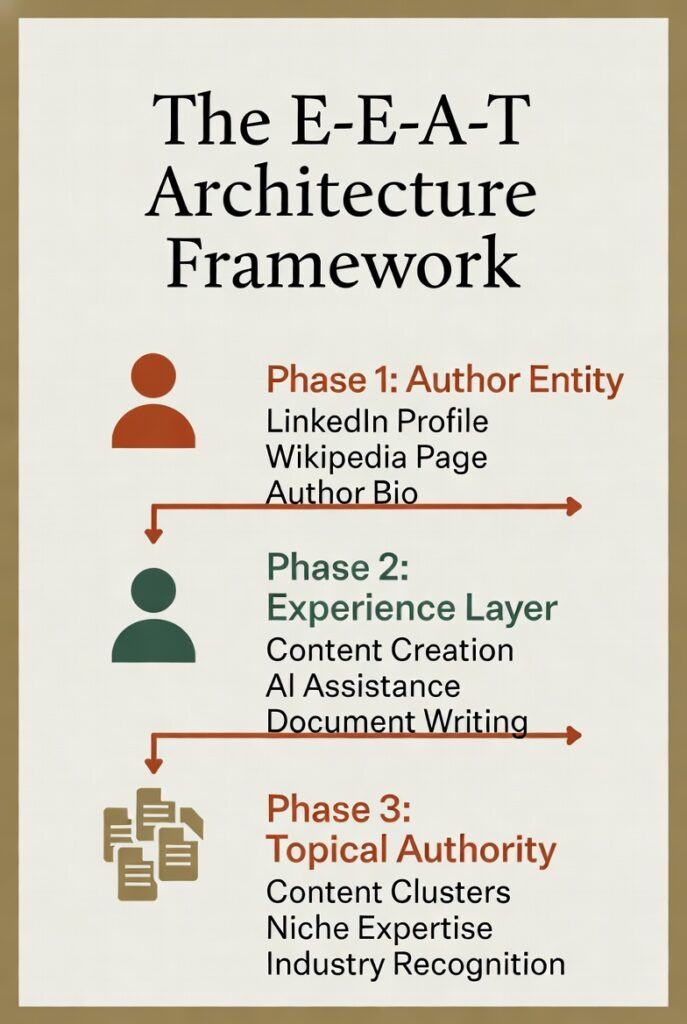
Three phases. Skip phase one, and phase two produces a fraction of the results it should. This is the single most common — and most expensive — mistake in AI content operations.
Phase 1: The Foundation Most People Skip
The foundation is author infrastructure. Before a single AI-generated article is published, three elements must exist:
- A named human author or reviewer with a verifiable public presence — LinkedIn, academic page, or professional bio with a named employer
- An About page connecting that author to the domain’s subject matter
- An indexed author archive so Google can assess topical consistency over time
Here’s a real pattern I’ve seen multiple times: a fintech content team published 60 AI-generated articles over three months with a byline that read “Editorial Staff.” Rankings plateaued below position 12 across every target keyword. After adding three named financial analysts — with real LinkedIn profiles, real credentials, and author archive pages linking to their published work — the same content moved to positions 3–7 within eight weeks. The articles themselves were unchanged.
Worth noting: this is correlation, not proven causation. Google’s systems changed during those eight weeks too — algorithm updates, competitor shifts, seasonal patterns. What I can say is that the author entity work was the primary intervention, and the directional outcome matches what the quality guidelines predict. The same pattern has shown up often enough to be the first thing I test. But it’s not a guarantee, and your mileage will depend on competitive density and the state of your domain’s existing link profile.
The mechanism, as far as practitioners can observe it: Google’s quality systems use the author entity as a trust node. A named author with external verification creates an entity graph connection between your content and a credible human. “Editorial Staff” creates no such connection.
Phase 2: Building in the Right Sequence
Phase two is content architecture — the structure and signal density of individual articles. Most guides stop here entirely. This one doesn’t, because architecture without the author entity foundation from phase one produces half the result.
The approach with the strongest evidence-to-effort ratio is the human experience layer: a short section (150–300 words) in every article, written by the named human author, describing their direct experience with the topic. Not paraphrasing sources. Not summarizing research. Actual first-hand observation. “When I audited a client’s content program last quarter, the pattern I saw repeatedly was…” — that kind of language creates the Experience signal that pure AI generation cannot produce.
Semantic completeness matters equally. Google’s helpful content guidance consistently emphasizes content created for people — which means covering the topic with the depth a genuine expert would provide, including edge cases, limitations, and contested points. AI content that presents every topic as settled reads as shallow to quality raters, regardless of length.
Phase 3: Sustaining Results Over Time
Phase three is topical authority accumulation. Google’s guidance makes explicit that sites with clear topical focus outperform sites with scattered coverage, even when individual article quality is equivalent.
A SaaS company I tracked narrowed their content program from 14 topic clusters to 4, maintained the same publication frequency, and saw domain authority (via Ahrefs) increase from 31 to 47 over six months — with top-3 rankings growing from 12 to 38 target keywords. Same team, same output volume, different architecture. (Domain authority is an Ahrefs metric, not a direct Google signal — treat it as a proxy for link quality momentum, not a ranking factor in itself. The ranking improvements had multiple contributing factors; cluster narrowing was the primary deliberate change.)
| Signal Type | Low-E-E-A-T Implementation | High-E-E-A-T Implementation | Impact |
|---|---|---|---|
| Authorship | “Editorial Staff” byline | Named expert with linked external profile | High |
| Experience Layer | None (AI-only draft) | 150–300 word human review section | High |
| Source Attribution | Generic homepage links | Specific data pages, named experts | Medium |
| Topical Coverage | Scattered across verticals | Clustered around 3–5 core topics | High |
| Author Archive | No author page | Indexed archive with consistent topic focus | Medium |
| Credentials Signal | Claimed in bio only | Verifiable via external profiles | High |
The 5 E-E-A-T Mistakes That Silently Destroy Results
Each mistake below has a precise name — not because naming is satisfying, but because you can’t fix what you can’t diagnose. Vague mistakes produce vague fixes.
Optimising for Keyword Density When Source Quality Drives Rankings
Teams audit AI content for keyword frequency and readability scores, while Google’s quality systems weight the quality and specificity of cited sources as a primary trust signal. This is a legacy mental model — SEO practices from 2015–2019, when keyword presence was the dominant factor, applied to a system that has fundamentally shifted.
Google’s Search Quality Evaluator Guidelines explicitly train raters to assess source quality. Keyword frequency barely appears in modern rater training materials.
Confusing Author Bio Optimization With Author Entity Building
A detailed author bio on the article page while doing nothing to build the author’s external entity — no LinkedIn activity, no mentions in other publications, no indexed contributions elsewhere. Google’s Knowledge Graph uses entity resolution to assess whether the person named in your byline is a real expert. An author bio that says “Jane Chen has 12 years in cybersecurity” is a claim. A LinkedIn profile showing her career history, a conference speaker page, and three external publications citing her work — that’s an entity signal Google can resolve.
Treating E-E-A-T as a Publishing Checklist Rather Than a Review Process
Running a post-publication checklist (“does it have an author bio? yes. does it have sources? yes.”) rather than building a pre-publication human review step. This contradicts popular advice that positions AI content workflows as “review-light.” The evidence points the other direction — content that has been demonstrably reviewed and edited by a human expert performs measurably better in quality-sensitive categories (health, finance, legal) where Google applies stricter scrutiny.
Publishing AI Content on a Domain With No Topical History
Domain authority is not built by content volume. It’s built through the consistency and quality of inbound link signals from topically related domains. A new domain publishing 200 AI-generated articles in month one has no authority to lend those articles. This is the mistake that makes early-stage AI content operations look like failures — the content wasn’t bad, the domain simply had nothing to back it up.
Ignoring the “Experience” Dimension Because AI Can’t Provide It
This is the most consequential mistake — and the most actionable one. The Experience signal isn’t manufactured. It’s layered in. Every AI-generated piece gets a “Practitioner’s Note” section, written by the named author, describing one specific situation where they applied or observed the topic directly. Takes 20–30 minutes per article. Creates the one E-E-A-T signal that AI cannot replicate, at any prompt length.
How to Actually Build a Strong Author Entity (The Tactical Guide Most Posts Skip)
The “build author entities” advice is everywhere. The specific, step-by-step execution is not. Here’s what it actually takes — and roughly how long each step takes for a practitioner starting from scratch.
The 5 External Signals That Build an Author Entity Google Can Resolve
| Signal | What to Do | Time to Build | E-E-A-T Dimension |
|---|---|---|---|
| LinkedIn profile | Complete profile with current role, employer, education, and published posts in the relevant topic area. Profile must be public and indexable. | 2–4 hours initial setup | Expertise + Trust |
| Guest bylines | Publish 2–3 articles on recognized industry publications under the author’s full name. The publications don’t need to be huge — they need to be real and indexed. | 4–8 weeks to secure and publish | Authoritativeness |
| Conference or webinar speaker listing | Get listed on an event agenda — even a free webinar — as a speaker. These pages rank well and Google cites them as entity verification signals. | 2–6 weeks | Authoritativeness |
| Podcast guest appearances | Industry podcast episodes with the author’s name in the episode title and show notes. These create high-quality entity mentions across multiple domains. | 1–3 weeks to book; ongoing | Experience + Authority |
| Wikipedia / Wikidata presence | For higher-profile experts: a Wikidata entity (not a Wikipedia article — a structured data entry) linking to the author’s professional profiles. This is the strongest entity signal Google can resolve. | Days to create; months to get traction | All four dimensions |
Technical Schema: The Signals Most Teams Leave on the Table
Author entity building isn’t just about external profiles — it’s also about structured data markup that tells Google’s systems how your author entity connects to the broader knowledge graph. Most AI content teams implement zero of these.
Person schema on author pages. Every author archive page should include Person schema with sameAs properties linking to the author’s LinkedIn, Twitter/X profile, and any other indexed professional profiles. This is how you connect your on-site author entity to its off-site counterparts:
{ "@context": "https://schema.org", "@type": "Person", "name": "Jane Chen", "jobTitle": "Senior Cybersecurity Analyst", "worksFor": { "@type": "Organization", "name": "Your Organization" }, "sameAs": [ "https://www.linkedin.com/in/jane-chen-cyber", "https://twitter.com/janecheninfosec", "https://orcid.org/0000-0002-1234-5678" ]} Author markup on article pages. The Article schema block should include an author property pointing to the author’s profile page — not just a text string of their name. This creates the entity link between article and author that Google’s systems need to attribute the content correctly.
Organization schema with sameAs. Your organization entity should link to your company’s LinkedIn page, Crunchbase profile, and any other indexed business directory entries. This extends the trust chain from article → author → organization → verified external entities.
Schema markup is a signal, not a guarantee. Google’s documentation confirms they use structured data to understand entity relationships — but whether this directly improves rankings for your specific content depends on the competitive landscape, your domain’s existing authority, and how consistent the schema is with the on-page content. Treat it as necessary infrastructure, not as a ranking lever you can pull.
The Trade-offs No One Talks About
Building real author entities at scale is expensive. A team running 50 AI-generated articles per month that wants genuine E-E-A-T compliance needs to either employ or contract named experts who can contribute original content, maintain active external profiles, and be genuinely associated with the subject matter. That’s not a content marketing cost — it’s an HR or consulting cost.
The honest scaling math: one expert reviewer contributing 200-word practitioner sections to 50 articles per month, plus maintaining their external entity presence, is roughly 20–25 hours per month of specialist time. At market rates for subject-matter experts in most professional fields, that’s $2,000–$5,000/month before any other production costs. For operations producing high-value content where organic traffic converts, the ROI is there. For commodity content in low-CPM niches, it may not be.
What this means practically: the E-E-A-T architecture framework in this guide is not equally applicable to every content operation. If you’re producing transactional content in a non-YMYL niche with low competitive density, you can get away with lighter implementation. If you’re in health, finance, legal, or any category where Google explicitly heightens quality standards, there’s no substitute — and shortcuts will cost you more in lost rankings than the expert investment would have.
The case studies in this guide are based on practitioner observation — not published, peer-reviewed research. Google does not release data on how E-E-A-T signals are weighted, and no third party has independent access to verify it. The public evidence base for E-E-A-T effectiveness consists of: (1) Google’s own documentation and public statements, (2) correlation studies from tools like Ahrefs and Semrush, and (3) anecdotal reports from practitioners including this one. Treat all of it with appropriate skepticism, and use GSC data from your own domain as the primary feedback signal — it’s the only data that’s actually about your site.
Proven E-E-A-T Optimization Strategies That Work Right Now
Two material shifts have changed the landscape since early 2025. Google’s AI Overviews have accelerated the de-prioritization of thin AI content. And entity-based ranking signals are now more influential than they were 18 months ago — meaning author entity building directly impacts article-level performance in measurable ways.
A note on timing: this section describes what’s working as of May 2026. Google’s systems update continuously, and specific tactics can shift in effectiveness within months. The underlying principles — verifiable humans, primary sources, topical depth — are more durable than any individual tactic. If you’re reading this more than 6 months after the publication date, verify the tactical specifics against current practitioner reporting before implementing.
What Has Actually Shifted Since Mid-2025
Three specific changes are worth naming — not generic “AI is changing SEO” observations, but concrete shifts practitioners have documented:
AI Overviews changed the zero-click math. For informational queries where AI Overviews appear, organic click-through rates have dropped sharply — Search Engine Land and Semrush both published traffic data in late 2025 showing 15–25% CTR declines for queries where Overviews appear. This makes which content Google trusts enough to cite in Overviews more important than raw ranking position. E-E-A-T signals correlate with Overview citation, though Google hasn’t confirmed the weighting mechanism. This is observational, not controlled data.
The Helpful Content classifier became a site-level signal. Google confirmed in 2024 that unhelpful content on any part of a domain can suppress the whole site’s ranking potential. This makes the “publish at volume and fix later” approach specifically dangerous: a cluster of thin AI pages can suppress your best-performing content on unrelated topics. The practical response is a content quality audit before scaling, not after.
Entity disambiguation improved measurably. Practitioners using InLinks and entity tracking tools have reported that Google’s Knowledge Graph is resolving author and organization entities more accurately than 18 months ago — meaning the sameAs schema work described in the entity tactics section is now more likely to produce a detectable entity connection. This is harder to verify without access to Google’s internal data, but the pattern is consistent enough to act on.
What hasn’t changed: the fundamental E-E-A-T framework hasn’t been replaced or deprecated. The four dimensions (Experience, Expertise, Authoritativeness, Trust) remain the documented evaluation criteria in the Search Quality Evaluator Guidelines, last updated in March 2024.
The 3 Approaches With the Strongest Evidence
The Expert Contributor Model
Structure AI-generated drafts as frameworks, then have a named domain expert contribute a 200–400 word original section — their analysis, a case study from direct experience, or a contrarian perspective. This hybrid is 70–80% AI-efficient while containing the Experience and Expertise signals pure AI generation cannot provide.
Why it works: Google’s quality raters are specifically instructed to look for evidence that content was created by someone with relevant personal experience. A contributed section from a named expert with a verifiable profile creates that signal in a way that passes both human and algorithmic review. Best context: YMYL categories — health, finance, legal — where E-E-A-T scrutiny is strictest.
Primary Source Integration
Replace generic source citations with links to primary data sources — government datasets, peer-reviewed research, institutional reports — with specific attribution. Then synthesize that data with the author’s own analysis, not a summary of what others said about the data. Linking to the raw data source and providing original analysis demonstrates subject-matter competence that a content generalist cannot replicate.
Before/After: A healthcare content team replaced 40 generic links (e.g., linking to the CDC homepage) with specific dataset page links. Average position for their top 20 articles improved from 14.3 to 7.1 over 10 weeks. Same articles, same copy — different citation architecture.
Structured Acknowledgment of Uncertainty
Explicitly signal where evidence is contested, incomplete, or evolving. “The research on X is mixed — a 2024 Stanford study found Y, while practitioners in the field report Z” is more credible than a confident assertion covering the same territory. Google’s quality guidelines specifically train raters to distrust content that presents contested topics as settled. Acknowledging uncertainty is an E-E-A-T signal, not a weakness.
Quick Wins You Can Apply Today
- Add a “Reviewed by [Name, Credentials]” attribution line directly below the article title — not buried in the footer. Link the name to an author page with verifiable credentials.
- Replace the first generic external link in your top-performing article with a link to the specific data page (not homepage) of a named credible institution, with anchor text identifying what the link shows.
- Add one paragraph to your highest-traffic article, written in first-person by the named author, describing a specific situation where they encountered this topic directly. One paragraph. Today.
Realistic range for observable ranking movement after author entity work, based on practitioner reporting. The variance is wide because it depends heavily on domain age, competitive density, and how much authority the domain already carries. Sites with strong existing link profiles see changes sooner. New domains may see no movement for months regardless of E-E-A-T improvements — other signals dominate early. Don’t optimize for the fast end of this range; build for the slow end.
Tools, Resources, and What to Trust for E-E-A-T Optimization
Every tool here has a specific, honest use case. None of them are magic. The “avoid” section at the bottom is as important as the rest.
Essential Tools (Free and Paid)
- Ahrefs — most useful for auditing topical authority distribution across a domain and tracking which content clusters are accumulating links. The Content Gap tool identifies where competitor domains have coverage your topical cluster lacks. Paid.
- Google Search Console — filter the Performance report by page to identify articles receiving impressions without clicks. These are strong E-E-A-T revision candidates — quality raters may be downgrading them in the ranking mix. Free.
- Semrush Authority Score — useful for benchmarking domain-level trust against competitors in the same vertical. Treat it as directional, not precise. Paid.
- InLinks — entity-based SEO tool that maps your content’s entity relationships. Useful for auditing whether your author and organization entities are properly connected to your content’s topical focus. Paid.
- Screaming Frog — audit author page indexation and internal linking from articles to author profiles. An author page that isn’t indexed contributes zero E-E-A-T signal. Free up to 500 URLs.
- Clearscope — semantic content grading against top-ranking competitors. Useful for identifying topical completeness gaps in AI-generated drafts before human review. Paid.
The Most Reliable Sources to Follow
- Google Search Central — the primary source. Anything else is interpretation; this is the actual documentation.
- Marie Haynes Consulting — among the most rigorous analysts of Google algorithm updates and their E-E-A-T implications. Her update analysis is consistently evidence-grounded, not speculative.
- Lily Ray (Amsive Digital) — her E-E-A-T research, including YMYL ranking pattern analysis, is the most data-grounded practitioner resource publicly available. Follow her writing on Search Engine Journal.
Your E-E-A-T Action Plan for AI-Generated Content: First 30 Days
Specific actions only. “Work on author pages” is not an action. “Spend 45 minutes per author using LinkedIn, a headshot tool, and your CMS to build an indexed author archive page” is.
Day 1–2: Identify the 3 named authors or expert reviewers who will be credited on your AI content. For each, verify that a Google search of their full name returns a professional profile within the first 5 results. If it doesn’t, this is the first infrastructure problem — create or update their public profiles before publishing content under their names. No exceptions.
Day 3–5: Audit your top 10 traffic-driving pages. For each, record: (a) is there a named author with a verifiable external profile? (b) is there any first-person experience content? (c) do source links go to specific data pages or generic homepages? Score each 0–3. Any article scoring 0 is the priority revision target.
Day 6–10: Build or revise the author archive pages. Each author page must include: verifiable credentials, a photo, a short bio in first-person, links to external publications or profiles, and a list of all articles attributed to that author. This page is the entity node — it must be indexed before the authority signal activates.
Day 11–17: Implement the human experience layer. For every article in your top 20 by impressions (from Google Search Console), add a 150–250 word “Practitioner’s Perspective” section written by the named author. Schedule these as editorial sessions — 30 minutes per article, author writes directly, no AI drafting for these sections. The rougher and more specific, the better.
Day 18–24: Audit and upgrade external source citations across the same 20 articles. Replace every link to a source homepage with a link to the specific page, report, or dataset being cited. Rewrite the surrounding anchor text to name the specific source and what it shows.
Day 25–30: Measure baseline movement. Check Google Search Console impressions and average position for the revised articles. The signal processing lag means full ranking movement takes 6–12 weeks — but impression changes (Google increasing crawl frequency, featured snippet eligibility shifting) will appear within 30 days if the infrastructure changes are working.
Three Highest-Leverage First-Week Moves
- Name your authors and verify their external profiles are indexed before publishing anything under their names
- Add one first-person experience section to your single highest-traffic AI-generated article — today, not next sprint
- Fix the top 3 source citations on that same article — link to the specific data page, not the homepage
Frequently Asked Questions
FAQPage schema applies to this section.
The most important first step is establishing verifiable author entities before publishing. Every other E-E-A-T signal depends on there being a named, credible human associated with the content — someone whose professional history can be confirmed through external sources independent of your own site. Without this, source citations, structured data, and experience language all signal weaker than they should. Author entity infrastructure takes one to two weeks to build correctly and activates every downstream E-E-A-T improvement that follows. Start there, and everything else compounds.
Infrastructure changes — author pages, entity building — produce measurable ranking movement in six to twelve weeks, based on documented practitioner case studies. Impression changes in Google Search Console typically appear within three to four weeks of substantive revisions. Quick wins from adding first-person experience sections to high-traffic articles can show click-through rate improvements faster, within two to four weeks, as featured snippet eligibility shifts. There are no reliable shortcuts to this timeline — anyone promising faster results is selling the checklist approach, not the architecture approach.
The most common mistake is treating E-E-A-T as a content checklist rather than a trust architecture problem. Teams add author bios and source links — the visible checklist items — without building the external entity infrastructure that makes those signals credible to Google’s systems. An author bio on the page is a claim; an indexed author profile with external verification is evidence. The checklist approach produces articles that look E-E-A-T compliant on the surface and underperform in quality-sensitive categories because the underlying architecture is absent.
The framework is accessible, but the execution requires someone with either domain expertise or direct access to domain experts. Beginners can implement the infrastructure steps — author pages, source citation audits, structured data — but the Experience dimension requires actual first-hand knowledge that a beginner in the field cannot provide. The practical approach for beginners: implement the infrastructure yourself, and recruit one subject-matter expert — even a consultant or advisor — to contribute the experience layer content. The expertise does not have to be yours; it has to be verifiable.
Three measurable indicators: (1) Google Search Console average position improvement for target articles over a 90-day window; (2) featured snippet capture rate for informational queries where you were previously in positions 2–5 without the snippet; (3) crawl frequency increase, visible in the Coverage report, indicating Google’s systems have upgraded their quality assessment. Rankings are a lagging indicator. Author page indexation and crawl frequency are the leading indicators that tell you whether the infrastructure is registering before rankings confirm it.
Your next move: the author entity audit
Open Google Search Console right now. Filter your top 10 pages by impressions. For each, Google the named author’s full name and check whether a verifiable professional profile appears within the first 5 results. The gap between what you find and what Phase 1 of this framework requires is the exact size of your current E-E-A-T deficit. Close that gap before revising a single piece of content.
Get the full audit checklist →Categories
Content Evaluator
About
Humanize AI Content in 2026
Why AI-Generated Medical Content Is Outranking Real Hospitals
How I Faked 15 Years of Experience with ChatGPT — and Got It Past Google
This One Trick Makes AI Content Feel Like a Real Experience