
By Tom Morgan · Reviewed for technical accuracy by Dana Whitfield · Updated September 2026 · 13 min read
Structured data cannot win clicks back from zero-click searches — it makes your content legible enough to be cited inside them. The sites that dominate in 2026 treat schema as an eligibility layer for entity comprehension, then measure success in citations, branded search demand, and AI-referred conversions rather than raw traffic.
TL;DR
- Roughly 68% of US Google searches now end without a click (SparkToro/Similarweb, June 2026). Competing for the click on those queries is a losing game.
- Schema doesn’t move rankings, and current evidence says it doesn’t move AI citations either — once a page is already visible. What it appears to do instead is set a floor: on pages machines genuinely can’t parse, it may decide whether they get read at all.
- The largest controlled test to date (Ahrefs, 1,885 pages) found that adding schema does not boost AI citations on pages already visible. Its value shows up earlier — as a threshold for pages machines cannot yet parse — and that’s a narrower job than most schema advice claims.
- Build the entity layer first (Organization, Person,
sameAs), stack durable types (Breadcrumb, Article, Product, Video, LocalBusiness), and keep FAQPage only where genuine Q&A content exists. - Measure citations, brand-search lift, and AI referral conversions — not clicks.
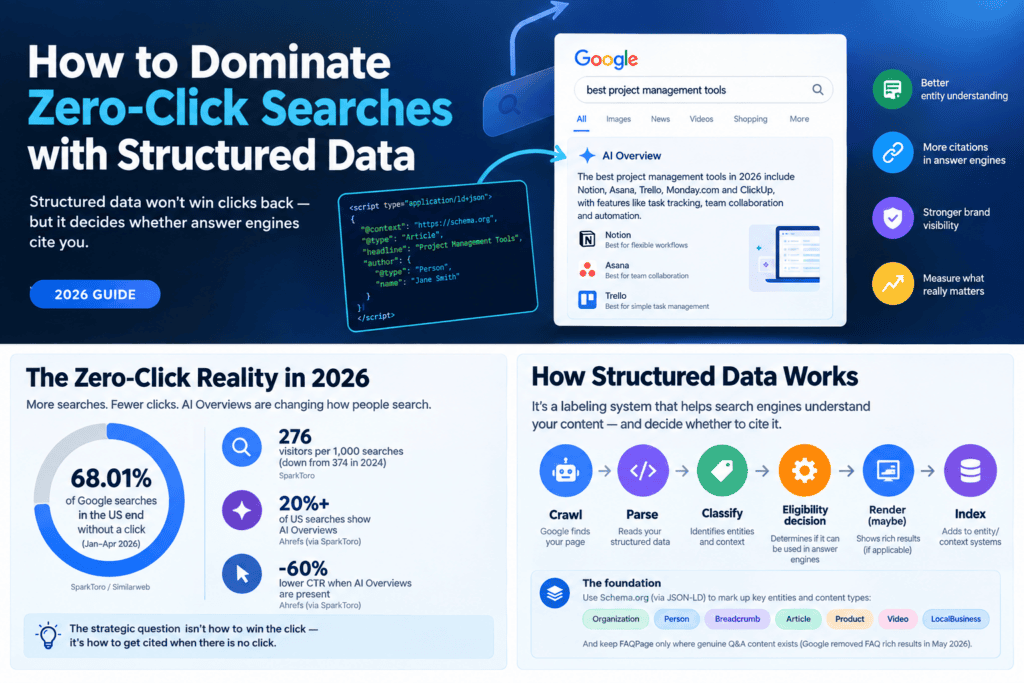
In the first four months of 2026, 68.01% of Google searches in the United States ended without a single click to any website. For every 1,000 searches typed into Google, 276 sent a visitor somewhere on the open web — down from 374 just two years earlier, according to SparkToro’s analysis of Similarweb clickstream data. The search industry spent two decades optimizing a funnel whose final step is quietly being removed.
Most schema advice circulating today was written for a world that no longer exists. It tells you to add FAQ markup to win expandable rich results — Google removed FAQ rich results entirely in May 2026. It tells you schema is “the key to AI visibility” — the largest controlled test on record found it does no such thing. And it tells you structured data will lift your click-through rate, when the strategic question has already shifted: not how do I win the click, but how do I get cited when there is no click.
This article answers that question with the actual evidence — including the parts that contradict the comforting version.
The click stopped being the unit of value
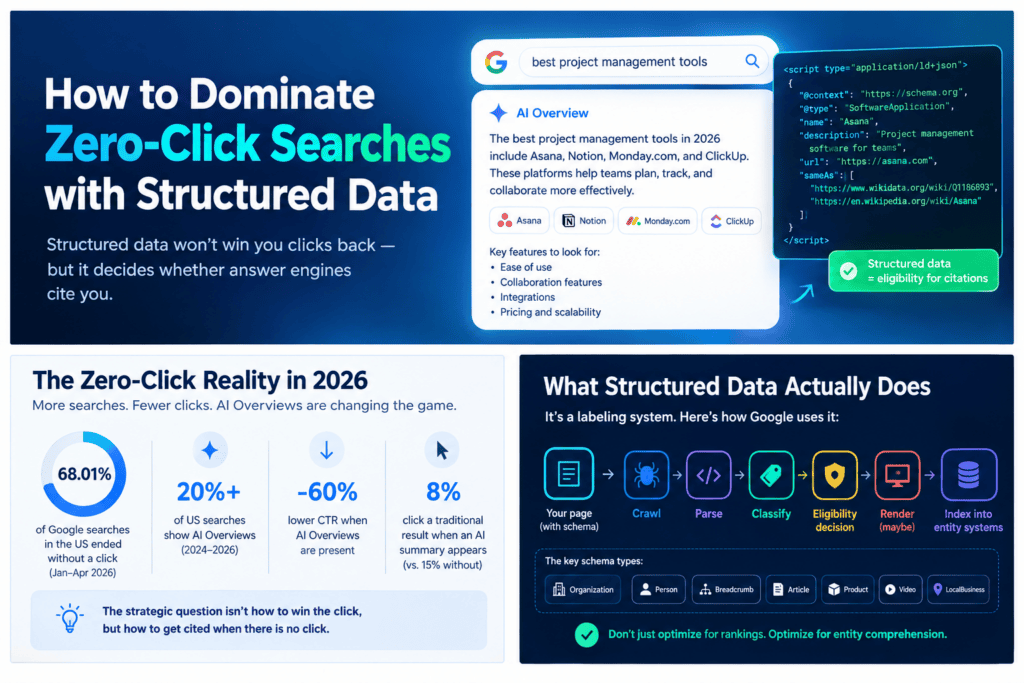
The zero-click trend predates generative AI. SparkToro first measured it at roughly half of searches in 2019, using Jumpshot panel data. What changed in 2024–2026 is the acceleration: AI Overviews now appear on more than 20% of US searches and cut click-through rates by roughly 60% when present (per Ahrefs trigger data cited in the 2026 SparkToro study), and the two-year jump to 68.01% zero-click is the fastest on record.
The behavioral evidence is blunt. Pew Research Center tracked 900 US adults across 68,879 real Google searches in March 2025 and found that when an AI summary appeared, users clicked a traditional result 8% of the time versus 15% without one. Only 1% clicked a link inside the summary. Users ended their browsing session entirely on 26% of searches with an AI summary, versus 16% without. (Pew Research Center, July 2025)
One correction before we continue: the measurable driver of zero-click today is AI Overviews, not AI Mode. Google routes barely 0.34% of searches to AI Mode, despite the headlines. A strategy built around the AI Mode apocalypse is preparing for the wrong threat; AI Overviews are eating the clicks right now.
Here is the strategic consequence most articles dodge: you cannot dominate a zero-click search by ranking for it, because the click no longer exists to win. You can only dominate within it — by being the source the answer engine cites, names, or synthesizes. That is a different optimization target, and it is exactly where structured data does its real work.
What structured data actually does
Strip away the folklore and structured data is a labeling system. You annotate page content with a shared vocabulary (Schema.org, maintained jointly by Google, Microsoft, Yahoo, and Yandex), typically via a JSON-LD script block in the page head. Google’s pipeline then does something specific with those annotations:
Crawl → Parse → Classify → Eligibility decision → Render (maybe) → Index into entity/context systems
Two things matter about this chain. Google has stated consistently that structured data is not a direct ranking factor — it doesn’t push a page higher, it makes a page eligible for enhanced treatment, and at the comprehension layer, eligible to be machine-readable at all. And the output of that eligibility check splits into two very different layers, which Google’s own behavior over the past three years shows should never be conflated: The Two-Layer Model: What Happens to Your Markup Visible content HTML a human reads JSON-LD markup Schema.org labels Parsing & classification DISPLAY LAYER (rich results) Stars, prices, breadcrumbs, accordions, video previews REVOCABLE — Google retires these when abused (2023–2026) COMPREHENSION LAYER Entity understanding, knowledge graph resolution, AI answer sourcing DURABLE — Google keeps using markup to understand pages Schema bought you eligibility at both layers. Only the green one compounds.
The display layer is everything you can see: star ratings on products, breadcrumb trails, video thumbnails, and — until May 2026 — FAQ accordions. Google gives these features and Google takes them away. The comprehension layer is invisible: markup that tells machines what your page is, who authored it, what organization stands behind it, and how it relates to known entities. When Google stripped away the FAQ accordion, its notice quietly preserved this second function, stating the company will continue to use FAQ structured data to better understand pages.
Every strategic decision that follows in this article flows from one rule: invest in markup that pays rent at the comprehension layer, and treat display-layer features as a bonus, never as a foundation.
The evidence is messy. Here is the honest read.
Any article that tells you schema definitively “boosts AI visibility” is overselling. The two most rigorous pieces of evidence on this question point in tension, and the resolution is more useful than either headline.
The case for schema: In a September 2025 experiment, Search Engine Land published three near-identical single-page sites differing only in markup quality. The site with well-implemented schema was indexed, ranked #3 for its target query, and appeared in an AI Overview. The site with poorly implemented schema ranked #8 and never appeared in an AI Overview. The site with no schema was crawled but never indexed at all. (Search Engine Land, September 2025)
The case against schema as a booster: In May 2026, Ahrefs published the largest controlled test to date. They tracked 1,885 pages that added JSON-LD schema between August 2025 and March 2026, matched them against roughly 4,000 control pages with similar citation profiles, and measured citation changes across Google AI Overviews, AI Mode, and ChatGPT using a difference-in-differences design. The result: a small but statistically significant 4.6% decline in AI Overview citations for treated pages (real, but not confidently attributable to schema itself, and tiny in absolute terms — about 12 daily citations on pages receiving hundreds), and +2.4% and +2.2% on AI Mode and ChatGPT, respectively — both indistinguishable from noise. Adding schema to already-visible pages moved nothing that mattered. (Ahrefs, May 2026)
How do you reconcile a study where schema seemed to make the difference with one where it demonstrably didn’t? Read the fine print of the Ahrefs methodology: every page in their dataset already had 100+ AI Overview citations before the test began. These were pages already inside the machine’s consideration set, which makes their study excellent evidence about one narrow question — schema is not a volume knob for pages the machine already trusts. The Search Engine Land experiment — three brand-new pages with zero history — is weaker, single-test evidence, but it points at a different, earlier question: below some threshold of machine legibility, a page may not get indexed, parsed, or attributed at all. Above that threshold, authority, content quality, and entity recognition do the ranking and the citing — schema just gets you into the room.
Two more data points sharpen the picture. A separate experiment by searchVIU (reported via Ahrefs’ analysis) found that five major AI systems — ChatGPT, Claude, Perplexity, Gemini, and Google AI Mode — extracted only visible HTML during live retrieval; JSON-LD, microdata, and RDFa were ignored at the moment of citation selection. And Ahrefs’ own analysis of 6 million URLs confirms why the correlation argument misleads: pages cited by AI are nearly three times more likely to carry JSON-LD — but that’s correlation riding on confounded variables (technically maintained sites do everything else better too), which is exactly what their controlled test then deconfounded.
The studies you’ll see quoted to claim schema skyrockets AI citations — a Frase study (FAQPage pages “3.2× more likely” in AI Overviews) and a Relixir analysis (41% vs 15% citation rates) — are small, vendor-adjacent, and uncontrolled. Mention them in a pitch deck if you must; don’t build a budget on them.
The honest synthesis: structured data functions as a threshold condition for visibility in an answer-engine world rather than a growth lever stacked on top of it. You implement it to make sure the machine can see, classify, and attribute you. What gets you cited above the threshold is authority, extractable content, and entity recognition — the Princeton GEO research found that adding verifiable citations, statistics, and quotations to content moved AI visibility by as much as 40% in controlled tests, which is a content-layer investment, not a markup trick. Schema and content quality are complements: one without the other wastes the other.
The deprecation ledger: what Google took back
From August 2023 to May 2026, Google executed the largest rollback of structured data support in its history. Read it as a pattern, because the pattern is the strategy lesson:
| Date | What Google removed | What survived |
|---|---|---|
| Aug–Sept 2023 | FAQ rich results restricted to authoritative government/health sites; HowTo rich results deprecated entirely | The markup itself; comprehension use |
| June 2025 | Seven more types retired: Book Actions, Course Info, Claim Review, Estimated Salary, Learning Video, Special Announcement, Vehicle Listing | Same |
| May 7, 2026 | FAQ rich results removed for all sites. June 2026: Search Console reporting and Rich Results Test support dropped. August 2026: API support removed | FAQPage remains valid Schema.org; Google states it will keep using FAQ markup to understand pages |
The mechanism behind every removal was identical: a feature got scaled by SEO tooling until it stopped faithfully describing pages, so Google narrowed eligibility, then deleted the feature. Lily Ray, VP of SEO & AI Search at Amsive, put a number on the pattern’s most recent cycle: by her count, roughly 168,000 articles pushed templated FAQ schema for “AI visibility” in the run-up to the May 2026 removal (practitioner-reported, but consistent with Google’s stated reasoning in 2023). Scale a display feature to that degree and you sign its death warrant.
Meanwhile, the types that survived share a property: they describe real entities and real page structure rather than manufacture extra SERP real estate. Product, Review and AggregateRating, Article, Recipe, Video, Organization, LocalBusiness, BreadcrumbList, and QAPage all continue to produce rich results as of September 2026, per Google’s current feature gallery.
The ledger’s real message isn’t “schema is dead” — it’s narrower and more useful than that: anything implemented purely to occupy pixels can be revoked on short notice, while anything that accurately describes your entities keeps compounding across every surface — classic search, knowledge panels, and AI answers alike.
The zero-click schema stack
Priority order for a zero-click strategy, ranked by durability of payoff:
| Priority | Schema type | What it earns in a zero-click world | Revocation risk |
|---|---|---|---|
| 1 | Organization + sameAs | Entity resolution: knowledge panels, correct brand attribution inside AI answers, disambiguation from competitors | Very low |
| 1 | Person (author) | Authorship attribution; who-said-what traceability that answer engines reward | Very low |
| 2 | BreadcrumbList | Clean URL hierarchy in results; helps machines map your site structure | Low |
| 2 | Article (+ author, datePublished) | Headline/date/author display; freshness signals for news and informational answers | Low |
| 3 | Product + AggregateRating | Price, availability, star ratings — still active and still clicked | Medium |
| 3 | VideoObject | Video rich results with key moments; feeds video surfaces | Medium |
| 4 | LocalBusiness | Direct answers for “near me” queries: hours, location, actions — high zero-click value | Low |
| 5 | FAQPage | No rich result since May 2026. Keep only where genuine Q&A content exists; it persists as a comprehension signal | Feature already gone |
The entity layer is the foundation. Organization markup with sameAs properties pointing to your Wikidata entry, LinkedIn, and other corroborating profiles is how machines confirm that the entity on your site is the same entity mentioned everywhere else — a prerequisite for being named in an answer rather than paraphrased anonymously. Google itself states that no special markup is required for AI Overviews or AI Mode, while requiring that any structured data match visible page content. Read those two statements together and the strategy writes itself: markup can’t buy your way into answers, but inconsistent or absent entity markup can keep you out of them.
A minimal Organization block looks like this:
{ "@context": "https://schema.org", "@type": "Organization", "name": "Your Company", "url": "https://example.com", "logo": "https://example.com/logo.png", "sameAs": [ "https://www.wikidata.org/wiki/Q1234567", "https://www.linkedin.com/company/your-company" ], "contactPoint": { "@type": "ContactPoint", "contactType": "customer support", "email": "support@example.com" }}Notice what this block doesn’t try to do: describe content, chase a feature, or manufacture SERP pixels. It states facts and points to corroboration. That’s the comprehension layer in eleven lines.
Validation — and the ways this breaks
Implementation discipline is where most schema efforts quietly rot:
- Validate with the right tools. The Rich Results Test still covers active rich result types, but FAQ support was removed from it in June 2026. For anything outside Google’s supported-feature set, use the Schema.org Validator to catch syntax and property errors.
- Markup must match visible content. Schema describing text the user cannot see is a manual-action risk regardless of whether a rich result fires. This rule survived every deprecation.
- Audit before you add. Crawl your site (Screaming Frog, Sitebulb, or equivalent) and inventory existing JSON-LD. Most teams don’t know which pages carry markup, and stale blocks describing deleted content are maintenance debt.
- Fix your dashboards. If you pull Search Console data through the API or BigQuery, the deprecated appearance fields — including FAQ — now return null or have been removed (October 2025 for the seven 2025 types; August 2026 for FAQ). Queries that filter on those fields will break silently.
- Don’t auto-generate. Plugins that manufacture FAQ schema from H2 headings produce technically valid noise. The H2s aren’t questions and the paragraphs aren’t answers, and machines are increasingly good at telling the difference.
The most common failure in 2026 isn’t invalid syntax — validators catch that on the first pass. The subtler problem is schema that describes nothing real: templated FAQ blocks replicated across every page, markup for content that lives only behind client-side rendering, and entity claims (founding date, awards, aggregate ratings) with no corroboration anywhere on the web. Search engines cross-check structured claims against visible content and external signals, so unverifiable markup is worse than none — it makes the machine trust you less the next time.
Measuring value when there is no click
If clicks aren’t the unit of value, what is? Four layers, in order of increasing confidence: The Zero-Click Value Flywheel Cited in AI answer / snippet Brand recognized Branded search & direct visits Entity signals reinforced Corroboration (mentions, reviews) Measured via: GSC impressions · AI trackers
- Impressions as a visibility proxy. Search Console impressions on queries where you hold a featured snippet or appear in AI surfaces tell you how often you are the answer, even when no click follows. Rising impressions on informational queries alongside flat clicks is often the strategy working, not failing — though impressions undercount AI answer exposure, so treat this as a floor, not a count.
- Brand-search lift. The strongest correlate of AI citation frequency in a 2025 analysis across major LLMs was branded search volume (correlation ~0.33) — not backlinks. Track branded query volume monthly in Search Console; it’s the most accessible downstream signal that answer-engine exposure is converting into demand. (Secondary-source finding; directional, not causal.)
- AI referral traffic and its quality. Tag referrals from ChatGPT, Perplexity, Gemini, and Copilot in GA4. The volume is still small, but multiple 2025–2026 analyses report AI-referred visitors converting at a multiple of organic — they arrive pre-endorsed. Track conversion rate on this segment separately before judging it by volume.
- Citation monitoring. Tools like Profound, Otterly, or Peec track how often and how favorably AI engines mention your brand on a panel of target queries (examples, not endorsements — this category is young, volatile, and priced for teams with real budgets). Run a manual 25-query panel across three engines monthly if you can’t justify the tooling.
Be honest about the limits: there’s no clean attribution chain from “cited in an AI Overview” to “revenue.” The measurement stack above triangulates; it doesn’t prove. Any vendor selling you exact zero-click attribution is selling a model, not a measurement.
Who this strategy disadvantages
Entity-first schema isn’t a meritocracy, and pretending otherwise would be marketing. Three groups start behind:
- New and low-authority sites. Structured data doesn’t substitute for authority, and the evidence above says it doesn’t manufacture citations either. A three-month-old site with perfect Organization markup and no corroborating mentions will still be ignored by answer engines. The realistic sequence is entity markup first (cheap, permanent), then the slow work of earning corroboration.
- Teams with thin content. Markup labels what is there. If what is there is thin, schema just makes the thinness more efficiently machine-readable.
- Small local businesses are the exception that proves the rule. LocalBusiness markup plus a maintained Business Profile still pays off directly — local packs and “near me” answers resolve to calls, directions, and bookings, which are zero-click outcomes with measurable value. If you’re local, this stack is arguably your highest-ROI technical work.
And the trade-off for everyone: a full schema program costs developer or plugin-maintenance time, and the visible return is deliberately shrinking. You’re investing in machine legibility for a funnel whose endpoint you no longer control. That’s a rational bet only if you also invest in the surfaces you do control — email, community, direct demand — so that answer-engine visibility has somewhere profitable to land.
The 90-day playbook
Weeks 1–2: Audit. Crawl the site; inventory every JSON-LD block; fix markup-content mismatches first (biggest risk); repair any Search Console API or BigQuery queries that still reference deprecated appearance fields.
Weeks 3–4: Entity layer. Implement Organization with sameAs (including a Wikidata entry if you lack one), Person markup for every identifiable author, and BreadcrumbList site-wide. Validate with the Rich Results Test and Schema.org Validator.
Weeks 5–8: Content pairing. For your 20 highest-value informational pages, restructure content for extraction — answer-first paragraphs of 40–60 words under query-mirroring H2s, named sources, statistics, at least one comparison table with proper headers. Add Article markup with author and date properties. This applies the Princeton GEO finding to pages your schema now labels correctly. Keep FAQPage markup only where a genuine Q&A section exists.
Weeks 9–12: Measure and iterate. Stand up the four-layer measurement stack from the previous section. Establish baselines for branded search volume, impressions on snippet-holding queries, and AI referral conversions. Re-check the panel quarterly, because citation patterns drift month to month — 40–60% monthly citation volatility is normal in current tracking data, so judge trends over two to three quarters, not weeks.
Where this leaves you
“Dominate zero-click searches” was always the wrong frame. A search that produces no click can’t be won by ranking for it — it can only be won from within, by being named, cited, and correctly attributed inside the answer that replaces the click. Structured data is how you make that attribution technically possible; authority and extractable content are how you earn it. The sites that internalize the difference — treating markup as infrastructure rather than a shortcut to visibility — are the ones the answer engines keep quoting. Start with the crawl. The machines are already reading; the only question is whether they can tell who you are.
Tom Morgan covers technical SEO and AI search for this site. Dana Whitfield reviewed this piece for factual accuracy before publication.